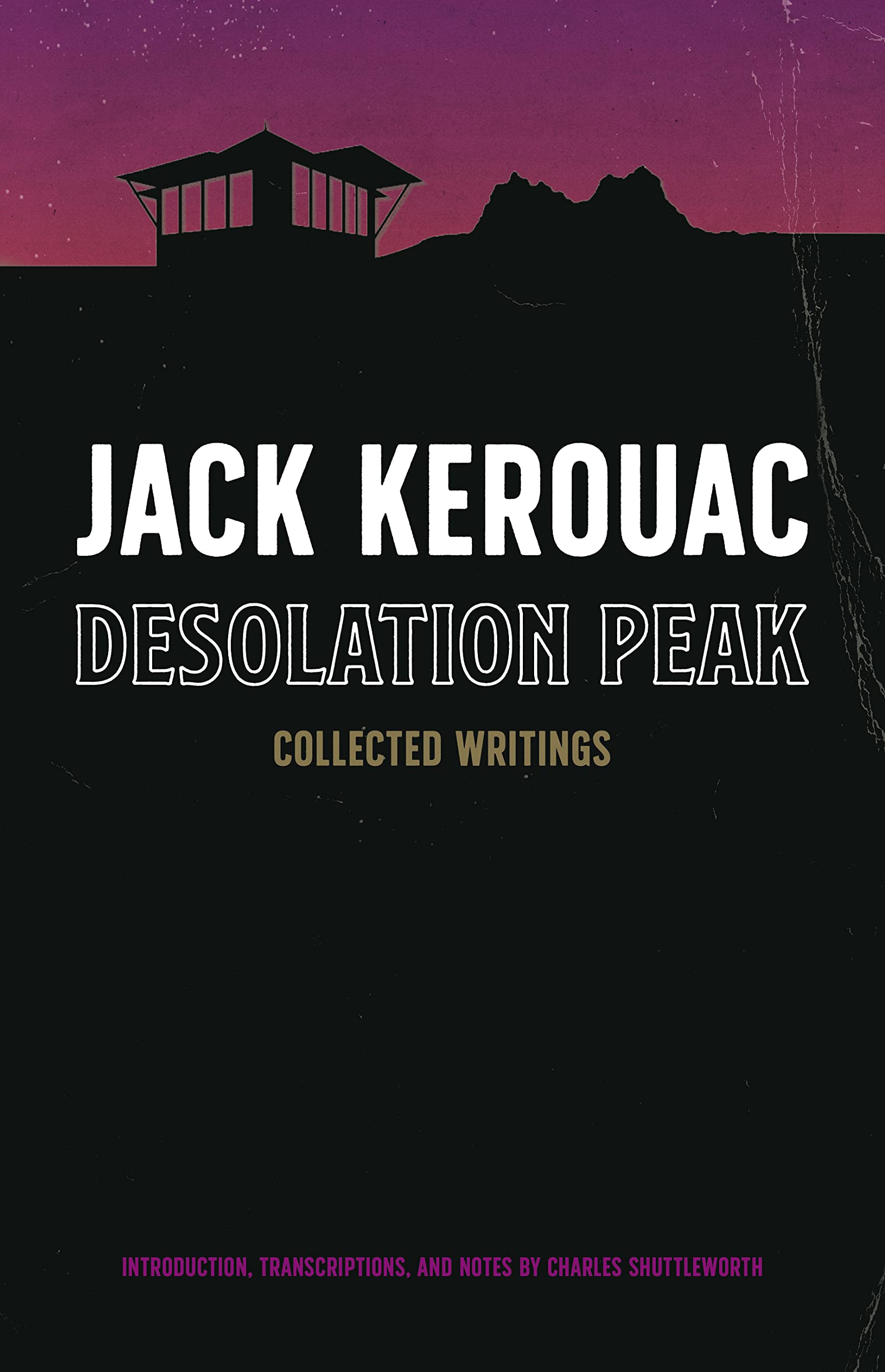
Desolation Peak
by Jack Kerouac
- Tytuł oryginalny
- Atomic Habits
- Język oryginału
- Angielski
- Liczba stron
- 320
- Wydawnictwo
- Avery
O tej książce
"Something will happen to me on Desolation Peak…I can feel it." In the summer of 1956, Jack Kerouac hitchhiked from Mill Valley, CA, to the North Cascades to spend two months serving as a fire lookout for the US Forest Service. Taking only the Diamond Sutra for reading material, he intended to spend his time in deep contemplation and to achieve enlightenment. He wrote in his journal that he planned "to concentrate on emptiness of self, other selves, living beings, and universal self." In letters to friends he proclaimed, "Something will happen to me on Desolation Peak…I can feel it." Kerouac's experience on Desolation Peak forms the climax of his novel The Dharma Bums and has also been depicted in part 1 of Desolation Angels and a chapter in his nonfiction book Lonesome Traveler . None of these versions offers a full, true picture, however; and for that reason, Desolation Peak is essential reading. What separates Kerouac from all other writers is the depth that he went in exploring his own consciousness, and what will prove his most enduring legacy is the record he left of that exploration, revealing the psyche of a sensitive, tortured artist grappling with himself in the mid-20th Century. The highlight of Desolation Peak is the journal he kept, starkly revealing the depth of his poverty, the extremity of his mood swings, and the ongoing arguments with himself over the future direction of his life, his writing, and faith. Along with the journal, he worked on a series of projects, including " Ozone Park ," another installment of the Duluoz Legend beginning in 1943, after his discharge from the Navy; " The Martin Family ," an intended sequel to The Town and the City , and " Desolation Adventure, " a series of sketches that became part 1 of Desolation Angels ,. In writing it, Kerouac was re-committing himself to his more experimental, then-unpublishable style, declaring in the journal that "the form of the future is no-form." Also included in Collected Writings is " The Diamondcutter of Perfect Knowing ," Kerouac's "transliteration" of the Diamond Sutra, his " Desolation Blues " and " Desolation Pops " poems, and assorted prose sketches and dreams.
Więcej od Jack Kerouac
100 Masterpieces of World Literature: 1984, On the Road, The Old Man and the Sea, Pride and Prejudice, Mrs. Dalloway, Moby-Dick, Ulysses, Frankenstein, The Chronicles of Narnia
Marcus Aurelius, F. Scott Fitzgerald, Leo Tolstoy, Fyodor Dostoevsky, George Orwell, Jonathan Swift, Sun Tzu, Niccolò Machiavelli, Lao Tzu, Erich Maria Remarque, Aldous Huxley, Ernest Hemingway, Robert Louis Stevenson, Charles Dickens, John Steinbeck, Lewis Carroll, Edith Wharton, George Eliot, Gustave Flaubert, James Joyce, Thomas Hardy, Albert Camus, Franz Kafka, William Faulkner, Jack London, Oscar Wilde, Nathaniel Hawthorne, Harriet Beecher Stowe, Louisa May Alcott, Mark Twain, John Milton, Kenneth Grahame, Nikolai Gogol, L. Frank Baum, Anne Brontë, Arthur Conan Doyle, Rudyard Kipling, William Makepeace Thackeray, Jane Austen, Johann Wolfgang von Goethe, Virginia Woolf, Ford Madox Ford, Joseph Conrad, Victor Hugo, D.H. Lawrence, Jules Verne, H.G. Wells, C.S. Lewis, L.M. Montgomery, Walt Whitman, Emily Brontë, Virgil, Ivan Turgenev, Stendhal, Raymond Chandler, Homer, Sylvia Plath, Herman Melville, T.S. Eliot, Carson McCullers, Richard Wright, Kate Chopin, Alexandre Dumas, Bram Stoker, Marcel Proust, Margaret Mitchell, Dante Alighieri, Henrik Ibsen, Sophocles, Daniel Defoe, E.M. Forster, Frances Hodgson Burnett, Charlotte Brontë, Plato, Miguel de Cervantes Saavedra, Wilkie Collins, Thomas Mann, Dashiell Hammett, Jack Kerouac, Mary Wollstonecraft Shelley, Friedrich Nietzsche, Evelyn Waugh, Malcolm Lowry, Neale Hurston
100 Poems
Jack Kerouac
36 blues
Jack Kerouac
Alone On A Mountain Top
Jack Kerouac