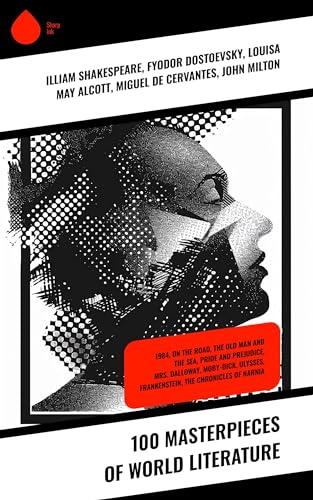
100 Masterpieces of World Literature: 1984, On the Road, The Old Man and the Sea, Pride and Prejudice, Mrs. Dalloway, Moby-Dick, Ulysses, Frankenstein, The Chronicles of Narnia
by Marcus Aurelius, F. Scott Fitzgerald, Leo Tolstoy, Fyodor Dostoevsky, George Orwell, Jonathan Swift, Sun Tzu, Niccolò Machiavelli, Lao Tzu, Erich Maria Remarque, Aldous Huxley, Ernest Hemingway, Robert Louis Stevenson, Charles Dickens, John Steinbeck, Lewis Carroll, Edith Wharton, George Eliot, Gustave Flaubert, James Joyce, Thomas Hardy, Albert Camus, Franz Kafka, William Faulkner, Jack London, Oscar Wilde, Nathaniel Hawthorne, Harriet Beecher Stowe, Louisa May Alcott, Mark Twain, John Milton, Kenneth Grahame, Nikolai Gogol, L. Frank Baum, Anne Brontë, Arthur Conan Doyle, Rudyard Kipling, William Makepeace Thackeray, Jane Austen, Johann Wolfgang von Goethe, Virginia Woolf, Ford Madox Ford, Joseph Conrad, Victor Hugo, D.H. Lawrence, Jules Verne, H.G. Wells, C.S. Lewis, L.M. Montgomery, Walt Whitman, Emily Brontë, Virgil, Ivan Turgenev, Stendhal, Raymond Chandler, Homer, Sylvia Plath, Herman Melville, T.S. Eliot, Carson McCullers, Richard Wright, Kate Chopin, Alexandre Dumas, Bram Stoker, Marcel Proust, Margaret Mitchell, Dante Alighieri, Henrik Ibsen, Sophocles, Daniel Defoe, E.M. Forster, Frances Hodgson Burnett, Charlotte Brontë, Plato, Miguel de Cervantes Saavedra, Wilkie Collins, Thomas Mann, Dashiell Hammett, Jack Kerouac, Mary Wollstonecraft Shelley, Friedrich Nietzsche, Evelyn Waugh, Malcolm Lowry, Neale Hurston
- Tytuł oryginalny
- Atomic Habits
- Język oryginału
- Angielski
- Liczba stron
- 320
- Wydawnictwo
- Avery
O tej książce
‘100 Masterpieces of World Literature’ stands as a monumental anthology that spans centuries, continents, and genres, presenting an unparalleled collection of works that have shaped, defined, and continually reinvent the vast landscape of literary tradition. Within its pages, the reader encounters the epic poetry of Homer, the existential musings of Dostoevsky, the pioneering narratives of Woolf, and the stark realism of Steinbeck, among others. This compendium not only showcases the diversity and richness of literary forms—from the novel to the sonnet, the manifesto to the play—but also highlights seminal pieces that have each, in their own right, contributed to the ongoing dialogue that defines what literature can be and do. The contributions of such a wide array of authors ensure that every reader will find both familiar echoes and challenging new voices. The backgrounds of these authors are as diverse as the texts they produced, spanning different centuries, countries, and cultural contexts. Their collective contributions underscore significant historical, cultural, and literary movements, reflecting the social and political climates from which they emerged. As a whole, the anthology provides a sweeping panorama of human thought and experience, capturing the essence of humanity's struggle, triumph, and transcendence across different epochs. The inclusion of authors from Shakespeare to Camus, and from Austen to Faulkner, offers a dialogue that transcends temporal and geographical boundaries, providing insight into the universality of human emotion and thought. ‘100 Masterpieces of World Literature’ is not merely a book; it is an expansive journey through the annals of literary greatness, inviting readers to immerse themselves in the depth and breadth of the world’s literary heritage. It is an essential tome for both the scholarly inclined and the casual reader, offering a unique opportunity to explore a multiplicity of perspectives, styles, and themes. This collection serves not only as an educational tool but as a testament to the enduring power of literature to connect disparate worlds, ideas, and emotions. For anyone seeking to comprehend the vastness of human expression through words, this anthology is an invaluable companion, illuminating the shared rivers of humanity that flow through the ages.