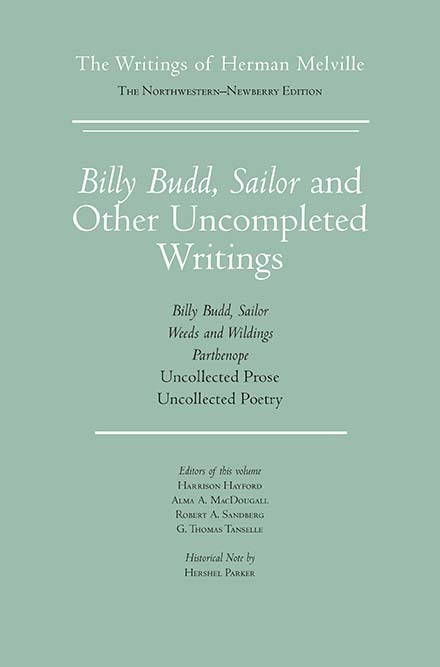
Billy Budd, Sailor and Other Uncompleted Writings
- Tytuł oryginalny
- Atomic Habits
- Język oryginału
- Angielski
- Liczba stron
- 320
- Wydawnictwo
- Avery
O tej książce
Billy Bud, Sailor ; Weeds and Wildings ; Parthenope ; Uncollected prose ; Uncollected poetryThe gripping tale of a handsome and charismatic young sailor who runs afoul of his ship’s master-at-arms, is falsely accused of inciting a mutiny, and hung, Billy Budd, Sailor is often treated as a masterpiece, a canonical work. But that assessment is at least partly founded on the assumption that the story was complete and ready for publication when it was left among the manuscripts on Melville’s writing desk when he died in 1891. As Hershel Parker has pointed out, “It is a wonderfully teachable story—as long as it is not taught as a finished, complete, coherent, and totally interpretable work of art.” Furthering Melville’s goal of getting his last literary projects into print, even in their imperfect forms, this last volume in the edition presents the poetry and prose that Melville was unable to finish, his sometimes ineffectual, sometimes heroic purposes betrayed by death. These unfinished writings include, besides Billy Budd, two projected volumes containing poems and prose pieces, Weeds and Wildings and Parthenope; three prose pieces, “Rammon,” “Story of Daniel Orme,” and “Under the Rose”; and some three dozen poems of varying lengths. Some of these pieces were surely composed late in Melville’s career, during his retirement, but others may date to as early as the 1850s. Except for Billy Budd, many of these works have not been readily available in reliable texts, when available at all. This volume, the result of the editors’ meticulous study of the manuscripts, offers new reading texts, with significant corrections of words, phrases, and titles, the inclusion of heretofore unpublished lines of verse, and the return to their original locations of the two poems, “The Enviable Isles” and “Pausilippo,” that Melville had extracted for use in John Marr (1888) and Timoleon (1891). Hershel Parker’s Historical Note traces how these writings fit into the trajectory of Melville’s career, and the rest of the Editorial Appendix presents the scholarly evidence and decisions made in creating the reading texts. As a whole, the Northwestern-Newberry Edition of The Writings of Herman Melville, now complete in fifteen volumes, offers for the first time the total body of Melville’s extant writings in a critical text, faithful to his intentions.
Więcej od Herman Melville
100 Eternal Masterpieces of Literature [volume 2]
Leo Tolstoy, Jonathan Swift, Robert Louis Stevenson, W. Somerset Maugham, James Joyce, Edgar Allan Poe, Jack London, Oscar Wilde, Mark Twain, H.P. Lovecraft, Walter Scott, Rudyard Kipling, D.H. Lawrence, Jules Verne, H.G. Wells, Rabindranath Tagore, Stendhal, Herman Melville, Rebecca West, Bram Stoker, Marcel Proust, Thomas Mann, George Sand, Upton Sinclair, Mary Wollstonecraft Shelley
100 Masterpieces of World Literature: 1984, On the Road, The Old Man and the Sea, Pride and Prejudice, Mrs. Dalloway, Moby-Dick, Ulysses, Frankenstein, The Chronicles of Narnia
Marcus Aurelius, F. Scott Fitzgerald, Leo Tolstoy, Fyodor Dostoevsky, George Orwell, Jonathan Swift, Sun Tzu, Niccolò Machiavelli, Lao Tzu, Erich Maria Remarque, Aldous Huxley, Ernest Hemingway, Robert Louis Stevenson, Charles Dickens, John Steinbeck, Lewis Carroll, Edith Wharton, George Eliot, Gustave Flaubert, James Joyce, Thomas Hardy, Albert Camus, Franz Kafka, William Faulkner, Jack London, Oscar Wilde, Nathaniel Hawthorne, Harriet Beecher Stowe, Louisa May Alcott, Mark Twain, John Milton, Kenneth Grahame, Nikolai Gogol, L. Frank Baum, Anne Brontë, Arthur Conan Doyle, Rudyard Kipling, William Makepeace Thackeray, Jane Austen, Johann Wolfgang von Goethe, Virginia Woolf, Ford Madox Ford, Joseph Conrad, Victor Hugo, D.H. Lawrence, Jules Verne, H.G. Wells, C.S. Lewis, L.M. Montgomery, Walt Whitman, Emily Brontë, Virgil, Ivan Turgenev, Stendhal, Raymond Chandler, Homer, Sylvia Plath, Herman Melville, T.S. Eliot, Carson McCullers, Richard Wright, Kate Chopin, Alexandre Dumas, Bram Stoker, Marcel Proust, Margaret Mitchell, Dante Alighieri, Henrik Ibsen, Sophocles, Daniel Defoe, E.M. Forster, Frances Hodgson Burnett, Charlotte Brontë, Plato, Miguel de Cervantes Saavedra, Wilkie Collins, Thomas Mann, Dashiell Hammett, Jack Kerouac, Mary Wollstonecraft Shelley, Friedrich Nietzsche, Evelyn Waugh, Malcolm Lowry, Neale Hurston
20 Must Read Classic Novels: Tom Jones, Pride and Prejudice, Emma, Wuthering Heights, the Scarlet Letter, Moby-dick, Bleak House, Madame Bovary, Great Expectations, War and Peace, and Many More…
Leo Tolstoy, Fyodor Dostoevsky, Charles Dickens, Gustave Flaubert, Nathaniel Hawthorne, Jane Austen, Emily Brontë, Ivan Turgenev, Herman Melville, Henry Fielding
39 Great Classics for Young Readers
Jonathan Swift, Robert Louis Stevenson, Charles Dickens, Lewis Carroll, Edgar Rice Burroughs, Jack London, Hans Christian Andersen, Louisa May Alcott, Mark Twain, Kenneth Grahame, L. Frank Baum, Rudyard Kipling, Jules Verne, Herman Melville, H. Rider Haggard, J.M. Barrie, Alice Caldwell Hegan Rice, Johanna Spyri, Eleanor H. Porter, Charles Kingsley, Susan Coolidge, Edward Eggleston, Jean Webster, Jane L. Stewart, Dorothy Kilner, Ethel C. Pedley, France Hodgson Burnett, George Fyler Townsend