

O tej książce
Isaac Newton was born in a stone farmhouse in 1642, fatherless and unwanted by his mother. When he died in London in 1727 he was so renowned he was given a state funeral—an unheard-of honor for a subject whose achievements were in the realm of the intellect. During the years he was an irascible presence at Trinity College, Cambridge, Newton imagined properties of nature and gave them names—mass, gravity, velocity—things our science now takes for granted. Inspired by Aristotle, spurred on by Galileo’s discoveries and the philosophy of Descartes, Newton grasped the intangible and dared to take its measure, a leap of the mind unparalleled in his generation.James Gleick, the author of Chaos and Genius, and one of the most acclaimed science writers of his generation, brings the reader into Newton’s reclusive life and provides startlingly clear explanations of the concepts that changed forever our perception of bodies, rest, and motion. Ideas so basic to the twenty-first century we literally take them for granted.
Gdzie kupić
Linki w tej sekcji są linkami afiliacyjnymi - jeśli po kliknięciu kupisz książkę, otrzymamy prowizję od sklepu. Cena dla Ciebie pozostaje taka sama.
Więcej od James Gleick
Chaos. Narodziny nowej nauki
James Gleick
Faster: The Acceleration of Just About Everything
James Gleick
Genius: The Life and Science of Richard Feynman
James Gleick

Nature's Chaos
James Gleick, Eliot Porter

Krótka historia geniuszy
Neal Stephenson, Richard Dawkins, Margaret Atwood, Gregory Benford, Ian Stewart, James Gleick, Paul C.W. Davies, Oliver Morton, Bill Bryson, Rebecca Goldstein, Henry Petroski, Simon Schaffer, Stephen H. Schneider, Philip Ball, Martin J. Rees, John D. Barrow, Richard Fortey, Margaret Wertheim, Maggie Gee, Georgina Ferrey
The Best American Science Writing 2000
James Gleick

Informacja. Bit, wszechświat, rewolucja
James Gleick

Time Travel: A History
James Gleick
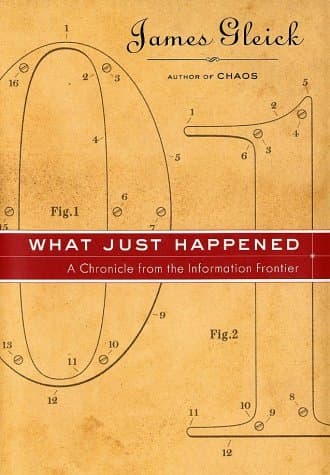
What Just Happened: A Chronicle from the Information Frontier
James Gleick