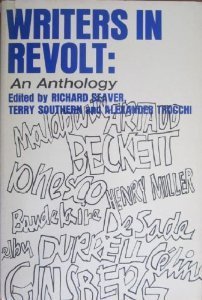
Writers in Revolt: An Anthology
by Fyodor Dostoevsky, Hermann Hesse, Jean-Paul Sartre, Samuel Beckett, Henry Miller, Allen Ginsberg, William S. Burroughs, Charles Baudelaire, Lawrence Durrell, Iris Murdoch, Antonin Artaud, Jean Genet, Hubert Selby Jr., William Gaddis, Louis-Ferdinand Céline, Eugène Ionesco, Curzio Malaparte, Richard Seaver, H.L. Mencken, Edward Dahlberg, Austryn Wainhouse, Evan S. Connell, Charles Foster, Chapman Mortimer, Marquis de Sade, E.S. Seldon
- Tytuł oryginalny
- Atomic Habits
- Język oryginału
- Angielski
- Liczba stron
- 320
- Wydawnictwo
- Avery
O tej książce
It has been said that all serious writing is meant to disturb, to trouble the reader and cause him to reassess values, both those evolved empirically and those imposed by the society or time in which he lives. Thus, through the ages, the serious writer has of necessity most often been in revolt: against injustice, hypocrisy, outmoded forms of expression, or simply the status quo. It was Sade's writing, rather than his libertinage, that kept him incarcerated, and judged as dangerous, for most of his adult life. When Baudelaire's 'Flowers of Evil' appeared in 1857, he, his publisher and printer were prosecuted "for offence to the public morals," and the book remained underground for many years. Antonin Artaud, one of the most lucid men who ever lived, spent many years in an asylum to which he had been committed ( as "dangerous"). And, most recently, Henry Miller has been pilloried in his homeland two decades after most civilized nations have accepted him as one of the most important literary figures of the century. But society does not always prosecute or condemn its literary rebels; more often it merely ignores them, while kowtowing to the popular or "slick" writer who in no way shocks the sensibilities of his contemporaries. Thus, paradoxically, the work currently termed "anti-literature" - as typified by the writing of Artaud, Ionesco, Beckett, et al - is, the editors conclude, not only the true heir of the rebellion which began with Sade, but also in the mainstream of important writing. Along with the work of writers whose names are well known, the editors have also chosen to include several selections by authors who they feel are of similar stature and deserving of wider recognition.Contents:Allen Ginsberg "Howl" (Part I & II)Sade from: La Philosophie dans le boudoir from: Pensée "Of the Clandestinite" by Austryn WainhouseBaudelaire from: Baudelaire by Jean-Paul Sartre from: The Intimate Journals of Charles BaudelaireDostoevski from: Notes from the UndergroundHerman Hesse from: SteppenwolfArtaud "No More Masterpieces"Celine from: Journey to the End of the NightMalaparte from: The SkinHenry Miller "On Henry Miller" by Lawrence Durrell from: Tropic of CancerIris Murdoch from: Sartre: "The Sickness of the Language"Genet from: Saint Genet by Jean-Paul Sartre from: Our Lady of the FlowersChapman Mortimer from: Young Men WaitingWilliam Gaddis from: The RecognitionsEvan S. Connell, JR. "The Fisherman from Chihuahua"Charles Foster "The Troubled Makers"Edward Dahlberg from: The Sorrows of PriapusH. L. Mencken Three Pertinent Essays from: "The National Letters" "The Anglo Saxon" "Libido for the Ugly"Hubert Selby JR. "Tra-la-la"William Burroughs On Naked Lunch by E. S. Seldon from: Naked LunchIonesco "The Avant-Garde Theatre"Samuel Beckett "The End"
Więcej od Fyodor Dostoevsky
A Picture, A Thousand Words
Jean-Paul Sartre, James Joyce, Simone de Beauvoir, Roberto Bolaño, Jean Genet, Georges Perec, Paul Éluard, Stacy Schiff, Jacques Lacan, Hélène Cixous, John Haskell, Eve Arnold, Barbara Bloom, Benjamin Péret, Louis Le Guillant
A imaginação
Jean-Paul Sartre
Altona/Men without Shadows/The Flies
Jean-Paul Sartre
Anti-Semite and Jew: An Exploration of the Etiology of Hate
Jean-Paul Sartre, Michael Walzer