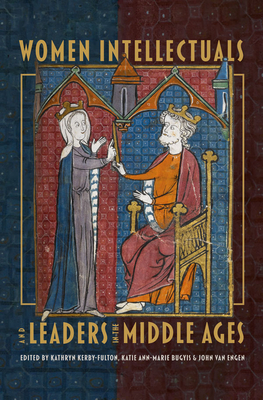
Women Intellectuals and Leaders in the Middle Ages
by Nicholas Watson, Dyan Elliott, Asma Afsaruddin, David Wallace, Barbara Newman, Jocelyn Wogan-Browne, Renate Blumenfeld-Kosinski, Maureen C. Miller, Kathryn Kerby-Fulton, Gary Macy, Sarah Foot, Sean L. Field, Rachel Koopmans, Adrienne Williams Boyarin, S.J. Pearce, Leanne MacDonald, Ruth Karras, F Thomas Luongo, Thelma Fenster, Sister Gemma Simmonds CJ, Anna Siebach-Larson, Amanda Bohne, Megan J. Hall, K.A. Bugyis
- Tytuł oryginalny
- Atomic Habits
- Język oryginału
- Angielski
- Liczba stron
- 320
- Wydawnictwo
- Avery
O tej książce
Wide-ranging examination of women's achievements in and influence on many aspects of medieval culture.Medieval women were normally denied access to public educational institutions, and so also denied the gateways to most leadership positions. Modern scholars have therefore tended to study learned medieval women as simply anomalies, and women generally as victims. This volume, however, argues instead for a via media. Drawing upon manuscript and archival sources, scholars here show that more medieval women attained some form of learning than hitherto imagined, and that women with such legal, social or ecclesiastical knowledge also often exercised professional or communal leadership.Bringing together contributors from the disciplines of literature, history and religion, this volume challenges several traditional firstly, the still-prevalent idea that women's intellectual accomplishments were limited to the Latin literate. The collection therefore engages heavily with vernacular writings (in Anglo-Saxon, Middle English, French, Dutch, German and Italian), and also with material culture (manuscript illumination, stained glass, fabric and jewelry) for evidence of women's advanced capabilities. But in doing so, the contributors strive to avoid the equally problematic view that women's accomplishments were somehow limited to the vernacular and the material. So several essays examine women at work with the sacred languages of the three Abrahamic traditions (Latin, Arabic and Hebrew). And a third traditional view is also that women were somehow more "original" for their lack of learning and and dependence on their mother tongue. Scholars here agree wholeheartedly that women could be daring thinkers in any language; they engage readily with women's learnedness wherever it can be found.
Więcej od Nicholas Watson
Communicating the Word: Revelation, Translation, and Interpretation in Christianity and Islam
Rowan Williams, John P. Langan, David Marshall, Reza Shah-Kazemi, Abdullah Saeed, Osman Bakar, Michael Ipgrave, John Azumah, Ellen F. Davis, Asma Afsaruddin, Lamin Sanneh, Susan Eastman, Daniel A. Madigan, Muhammad Abdel Haleem, Seyed Amir Akrami
Medieval Theology and the Natural Body (York Studies in Medieval Theology, 1)
Eamon Duffy, Alcuin Blamires, Dyan Elliott, Rosalynn Voaden, W.G. East, Peter Biller, David Luscombe
England and Bohemia in the Age of Chaucer
Julia Boffey, Michael J. Bennett, David Wallace, A.S.G. Edwards, Venetia Bridges, Dr Jan Dienstbier, Professor Lucie Doležalová, Dr Lenka Panušková, Dr Klára Petříková, Dr Marek Suchý, Professor Michael Van Dussen, Dr Helena Znojemská
La Guerre bactériologique: Les secrets des expérimentations japonaises
Peter Williams, David Wallace