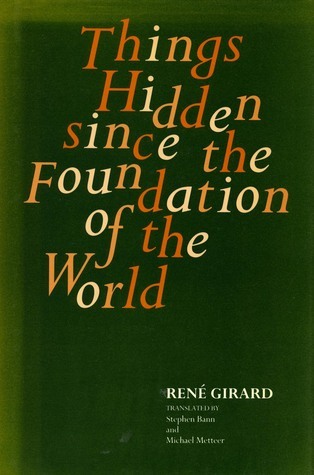
Things Hidden Since the Foundation of the World
by René Girard
- Tytuł oryginalny
- Atomic Habits
- Język oryginału
- Angielski
- Liczba stron
- 320
- Wydawnictwo
- Avery
O tej książce
An astonishing work of cultural criticism, this book is widely recognized as a brilliant and devastating challenge to conventional views of literature, anthropology, religion, and psychoanalysis. In its scope and interest it can be compared with Freud's Totem and Taboo, the subtext Girard refutes with polemic daring, vast erudition, and a persuasiveness that leaves the reader compelled to respond, one way or another.This is the single fullest summation of Girard's ideas to date, the book by which they will stand or fall. In a dialogue with two psychiatrists (Jean-Michel Oughourlian and Guy Lefort), Girard probes an encyclopedic array of topics, ranging across the entire spectrum of anthropology, psychoanalysis, and cultural production.Girard's point o departure is what he calls 'mimesis,' the conflict that arises when human rivals compete to differentiate themselves from each other, yet succeed only in becoming more and more alike. At certain points in the life of a society, according to Girard, this mimetic conflict erupts into a crisis in which all difference dissolves in indiscriminate violence. In primitive societies, such crises were resolved by the 'scapegoating mechanism,' in which the community, en masse, turned on an unpremeditated victim. The repression of this collective murder and its repetition in ritual sacrifice then formed the foundations of both religion and the restored social order.How does Christianity, at once the most 'sacrificial' of religions and a faith with a non-violent ideology, fit into this scheme? Girard grants Freud's point, in Totem and Taboo, that Christianity is similar to primitive religion, but only to refute Freud—if Christ is sacrificed, Girard argues, it is not because God willed it, but because human beings wanted it.The book is not merely, or perhaps not mainly, biblical exegesis, for within its scope fall some of the most vexing problems of social history—the paradox that violence has social efficacy, the function of the scapegoat, the mechanism of anti-semitism.
Więcej od René Girard
Christianity, Truth, and Weakening Faith: A Dialogue
Gianni Vattimo, René Girard
Marcel Proust's Remembrance of Things Past
Harold Bloom, Samuel Beckett, Walter Benjamin, Paul De Man, Georges Bataille, René Girard, David R. Ellison, Georges Poulet, Richard Terdiman, Richard A. Macksey
Reader in Comedy: An Anthology of Theory and Criticism
Samuel Johnson, William Hazlitt, Mark Twain, William Makepeace Thackeray, Virginia Woolf, Ben Jonson, Søren Kierkegaard, Sigmund Freud, Luigi Pirandello, Charles Baudelaire, Dante Alighieri, John Dryden, Philip Sidney, Samuel Butler, Plato, Northrop Frye, Stanley Cavell, Aristotle, Molière, Henri Bergson, Simon Critchley, Horatius, Henry Jenkins, George Meredith, Jacques Derrida, George Bernard Shaw, Oliver Goldsmith, Georges Bataille, William Congreve, Erasmus, Immanuel Kant, Charles Lamb, Henry Fielding, René Girard, George Gascoigne, Nicholas Udall, Kenneth Burke, Jean Paul Friedrich Richter, Jeremy Collier, Gerald Mast, Aphra Behn, Evanthius, John Lydgate, Susanne K. Langer, Michael North, Mahadev L. Apte, Stephen Gosson, Linda Hutcheon, Battista Guarino, Richard Blackmore, Thomas Wilson, Anthony Ashley Cooper, Constance Rourke, John of Salisbury, Mikhail Bakhtin, Donatus, Pope Honorius III, Quintilian, John of Garland, Magda Romanska, Hrotsvita, Thomas Elyot, Liudprand of Cremona, Gian Giorgio Trissino, Glenda R. Carpio, Ruth Wisse
Sartre: A Collection of Critical Essays
Fredric Jameson, Hazel E. Barnes, Eric Bentley, Edmund Wilson, Robert Champigny, René Girard, Claude-Edmonde Magny, Guido Morpurgo-Tagliabue, Kenneth Douglas, Jacques Guicharnaud, Henri Peyre, H.J. Blackham, Edith Kern, Oreste F. Pucciani, Rene Marill-Alberes, Theophil Spoerri, John D. Wild