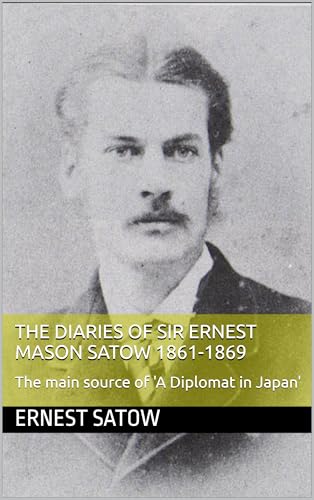
The Diaries of Sir Ernest Mason Satow 1861-1869: The main source of 'A Diplomat in Japan'
- Tytuł oryginalny
- Atomic Habits
- Język oryginału
- Angielski
- Liczba stron
- 320
- Wydawnictwo
- Avery
O tej książce
This is a reflowable Kindle ebook. A print replica Kindle ebook is also available.EDITORIAL PREFACE (extract)Those who transcribe and publish diaries and letters often feel the need to justify the necessity for yet another such publication. This is certainly true in the case of Ernest Satow’s 1861-1869 diaries because it cannot be denied that much of them fairly closely follow what he wrote in his published work about the period, A Diplomat in Japan.[1] Gordon Daniels, in his masterly introduction to the 1968 edition of that book commented, “though there are divergencies between the book and the original diaries, the two correspond so closely that the advantages of publishing the diaries as against reprinting the memoirs are little more than marginal”.[2]Obviously the editors of this volume do not agree, and with some reason. More than a third of the material in the diaries did not make it into the book in any form, and much that did was altered in ways that to historians of bakumatsu politics, and the British influence on them, are highly significant.The largest section of the diaries that was left out of A Diplomat in Japan is in fact their most interesting part on a human the account of Satow’s stay in China (January – August 1862). A Diplomat in Japan, as may be guessed from the title, confines itself to Japan although Satow laments in it, ‘I should like to dwell longer on our life in Peking’.[3] Satow’s time in China was short, but it was probably the most intense period of his life. He was young, excited, enthusiastic, and everything he saw was strange and novel. He came from a sheltered background, so even relatively ordinary interactions with colleagues and other Westerners were considered worth noting down. Averaged out, he wrote far more per day during his time in China than in Japan; around 20% of the diaries is taken up by the China section, although it represented less than 10% of his total stay.In the Japanese section, there are gaps lasting months, in spite of the fact that he tells us in A Diplomat in Japan that his diary was “kept almost uninterruptedly from the day I quitted my home”.[4] We do not know what happened during the gaps, but knowing Satow, they are very unlikely to have been empty of activity. But he had lost that initial impulse to record everything he did and saw, and started saving his efforts for the more significant happenings which, of course, were thick on the ground in 1860s Japan.For historians only interested in Japan, the main reason for reading these diaries is that they provide a franker, more immediate account of the events of the bakumatsu period than A Diplomat in Japan. As Daniels puts it, that book “illustrate[s] the force of hindsight”. The diaries are Satow’s raw and unmediated experiences. The publication of them allows a comparison of Satow’s thoughts at the time things happened, with how he felt years later and after he knew how events had turned out. In order to help readers compare the two versions, the editors have included sections of A Diplomat in Japan with the corresponding parts of the diaries.In the end, the diaries, rather than A Diplomat in Japan, are where we really see Satow as a human being...Robert MortonIan RuxtonSeptember 2013[1] Ernest Satow, A Diplomat in Japan, with an introduction by Gordon Daniels, Oxford University Press, 1968. Hereafter referred to as Diplomat in footnotes.[2] Diplomat, p. v.[3] Diplomat, p. 19.