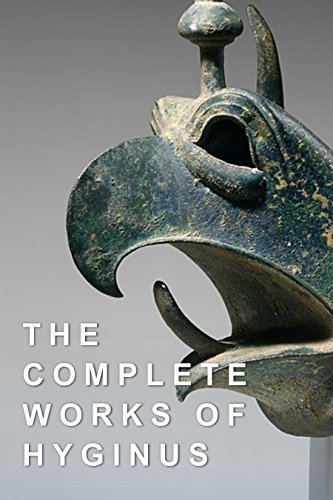
The Complete Works of Hyginus
by Hyginus
- Tytuł oryginalny
- Atomic Habits
- Język oryginału
- Angielski
- Liczba stron
- 320
- Wydawnictwo
- Avery
O tej książce
Gaius Julius Hyginus was a Latin author, a pupil of the famous Cornelius Alexander Polyhistor, and a freedman of Caesar Augustus. He was elected superintendent of the Palatine library by Augustus according to Suetonius' De Grammaticis, 20. It is not clear whether Hyginus was a native of the Iberian Peninsula or of Alexandria.“Astronomica” was first published, with accompanying figures, by Erhard Ratdolt in Venice, 1482, under the title Clarissimi uiri Hyginii Poeticon astronomicon opus utilissimum. This "Poetic astronomy by the most renowned Hyginus, a most useful work," chiefly tells us the myths connected with the constellations, in versions that are chiefly based on Catasterismi, a work that was traditionally attributed to Eratosthenes.Like the Fabulae, “Astronomica” is a collection of abridgements, and the style and level of Latin competence and the elementary mistakes (especially in the rendering of the Greek originals) were held by the anonymous contributor to the Encyclopedia Britannica (11th edition, 1911), to prove that they cannot have been the work of "so distinguished" a scholar as G. Julius Hyginus. It was further suggested that these treatises are an abridgment made in the latter half of the 2nd century of the Genealogiae of Hyginus by an unknown adapter, who added a complete treatise on mythology. Fabulae consists of some three hundred very brief and plainly, even crudely told myths and celestial genealogies, made by an author who was characterized by his modern editor, H. J. Rose, as adulescentem imperitum, semidoctum, stultum—"an ignorant youth, semi-learned, stupid"—but valuable for the use made of works of Greek writers of tragedy that are now lost. Arthur L. Keith, reviewing H. J. Rose's edition (1934) of Hygini Fabulae, wondered "at the caprices of Fortune who has allowed many of the plays of an Aeschylus, the larger portion of Livy's histories, and other priceless treasures to perish, while this school-boy's exercise has survived to become the pabulum of scholarly effort." Hyginus' compilation represents in primitive form what every educated Roman in the age of the Antonines was expected to know of Greek myth, at the simplest level. The Fabulae are a mine of information today, when so many more nuanced versions of the myths have been lost.In fact, the text of Fabulae was all but a single surviving manuscript from the abbey of Freising, in a Beneventan script datable c. 900, formed the material for the first printed edition, negligently and uncritically transcribed by Jacob Micyllus, 1535, who may have supplied it with the title we know it by. In the course of printing, following the usual practice, by which the manuscripts printed in the 15th and 16th centuries have rarely survived their treatment at the printshop, the manuscript was pulled only two small fragments of it have turned up, significantly as stiffening in book bindings. Another fragmentary text, dating from the 5th century is in the Vatican Library. (Major 2002)
Więcej od Hyginus
Apollodorus' Library and Hyginus' Fabulae: Two Handbooks of Greek Mythology
Hyginus
Constellation Myths: With Aratus's Phaenomena
Aratus, Hyginus, Eratosthenes
Das Feldmesserbuch. Ein Meisterwerk der spätantiken Buchkunst
Hyginus, Eberhard Knobloch
Ex Hygini Genealogiis Excerpta A Conrado Burnsian Restituta
Hyginus