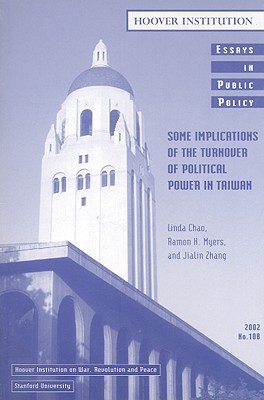
Some Implications of the Turnover of Political Power in Taiwan
by Ramon H. Myers, Linda Chao, Jialin Zhang
- Tytuł oryginalny
- Atomic Habits
- Język oryginału
- Angielski
- Liczba stron
- 320
- Wydawnictwo
- Avery
O tej książce
On March 18, 2000, Taiwan's citizens voted the Nationalist Party (KMT) out of office and the Democratic Progressive Party's candidate Chen Shui-bian in as president. The implications of this peaceful turnover of political party are that, instead of negotiating with mainland China's authorities to achieve a political settlement of the divided China problem, President Chen has opted for negotiations to take place under a special state-to-state relationship. At the same time, President Chen's administration has launched a "silent revolution"; promoting Taiwan a shared belief that Taiwan has the qualifications of a sovereign nation, that it has a special state-to-state relationship with mainland China, and that its people have the ethnic identity of Taiwan, not Taiwan and China. Meanwhile, the Chen administration, like the Lee Teng-hui administration before it, is changing symbols, rewriting Taiwan's history, and promoting cultural values of Taiwan inclusiveness to promote Taiwan nationalism and to carry out the de-Sinofication of Taiwan. In response, mainland China's authorities offered a new interpretation of the "one-China" principle, but the Chen administration rejected that concession. Political fragmentation continues. These developments have frozen cross-strait negotiations and put Taiwan and mainland China on a collision course. But long-term developments, such as growing integration of the Taiwan--mainland China market economies, a revitalized political opposition, and a favorable perception of mainland China's modernization could neutralize Taiwan's nationalism and restart cross-strait talks.
Więcej od Ramon H. Myers
Democracy's New Leaders in the Republic of China on Taiwan (Hoover Essays
Ramon H. Myers, Linda Chao
The Divided China Problem: Conflict Avoidance and Resolution
Ramon H. Myers, Linda Chao
The First Chinese Democracy: Political Life in the Republic of China on Taiwan
Ramon H. Myers, Linda Chao
A Tragic Beginning: The Taiwan Uprising of February 28, 1947
Ramon H. Myers, Lai Tse-Han, Wou Wei