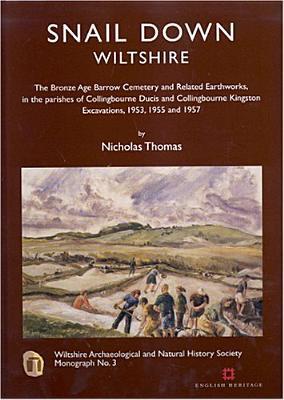
Snail Down
by Keith Thomas, Nicholas Thomas
- Tytuł oryginalny
- Atomic Habits
- Język oryginału
- Angielski
- Liczba stron
- 320
- Wydawnictwo
- Avery
O tej książce
Snail Down is an Early Bronze Age barrow cemetery on Salisbury Plain, located eight miles north-east of Stonehenge. Thirty-three mounds include examples of almost every type of Wessex bowl, bell, disc, saucer and pond type have all been excaveted there between 1953-7. The preferred burial rite at the site was cremation and disposal in burial pits. The land surrounding the cemetery is covered with the remains of ancient enclosures, ditches and other signs of habitation, suggesting that this area was in use for the last two millennia BC. This publication presents detailed analysis of an extraordinary variety of finds, backed up with illustrative material.Table of ContentsIntroduction; Concordance of barrow and earthwork numbers; An earthwork survey of Snail Down ( David Field and Mark Corney ); Part 1: The excavations, 1953, 1955, 1957 ( Nicholas Thomas ); Part 2: The finds and other specialist The human cremations, inhumation burials and fragments ( G H Bunting et al ); The trepanned cranial disc from Site II ( Ian Cornwall ); The Neolithic and Bronze Age pottery from the Beaker settlement ( Alex Gibson ); Collared urns, food vessels and accessory cups and vessels from the barrows ( Ian Longworth ); Bronze Age, Iron Age and Romano-British pottery associated with the linear ditch system ( Frances Raymond ); Romano-British pottery derived from agriculture around the barrow cemetery ( Kenneth Annable ); The flint ( Robert Young and Deirdre O'Sullivan ); Stone tools and sarsen ( Nicholas Thomas ); Worked bone ( Nicholas Thomas ); Beads from the burials ( Nicholas Thomas ); Early Bronze Age copper alloy awls from Sites I and II ( Nicholas Thomas ); Grave groups recovered by Hoare and Cunningham in 1805 ( Nicholas Thomas ); Miscellaneous artefacts, prehistoric and later ( Nicholas Thomas ); The Roman coins ( Marion Archibald ); Remains of the wild and domestic animals ( Juliet Clutton-Brock and Peter Jewell ); The molluscan material ( Arthur Cain and John Currey ); The charred plant remains and charcoal ( Camilla Dickson ); The Snail Down radiocarbon dates ( Paul Ashbee and Alex Bayliss ); Excavation mementoes left by Hoare and Cunningham ( Nicholas Thomas ); A study of the vegetation on the stripped barrow CK18 ( Salisbury Plain Training Area (East) Conservation Group, Sub-Group Botany ); Part 3: The anatomy of a Bronze Age barrow cemetery and its people ( Nicholas Thomas ).
Więcej od Keith Thomas
A New Voyage Round the World
Nicholas Thomas, William Dampier
A voyage round the world,
Georg Forster, Nicholas Thomas
An Ocean of Wonder: The Fantastic in the Pacific
Lehua Parker, Albert Wendt, Robert Sullivan, Craig Santos Pérez, Tina Makereti, Marama Salsano, Dan Taulapapa McMullin, Bryan Kamaoli Kuwada, Patricia Grace, Sloane Leong, Nicholas Thomas, Vilsoni Hereniko, John Puhiatau Pule, Robyn Kahukiwa, Steven Edmund Winduo, Emelihter Kihleng, Selina Tusitala Marsh, Solomon Enos, Terisa Siagatonu, Peter Rawlingson, Marie Alohalani Brown, Michael Lujan Bevacqua, Sosthène Desanges, Andrea Nicole Grajek, Lyz Soto, Joy Lehuanani Enomoto, Kathy Jetñil-Kijiner, Qianqian Ye, Kahala Johnson, Sarahina Sabrina Birk, Elizabeth Ua Ceallaigh Bowman, Alexander Casey, Ra`i Chaze, Laura De La Vega, Pono Fernandez, Nicole Ku`uleinapuananioliko`awapuhimelemeleolani Furtado, Sofia Kaleomālie Furtado, Aaron Ki`ilau, Victoria Nālani Kneubuhl, Caryn Lesuma, Nai`a Lewis, Mahinatea Shea McCallum, Brandy Nālani McDougall, Kapili`ula Naehu-Ramos, Jocelyn Kapumealani Ng, Tiare Ribeaux, Kristina R. Togafau, Briana Koani U`u, Brittany Winland, Māhealani Ahia
Ancient glass: The Bomford Collection of pre-Roman & Roman glass on loan to the City of Bristol Museum & Art Gallery
Nicholas Thomas