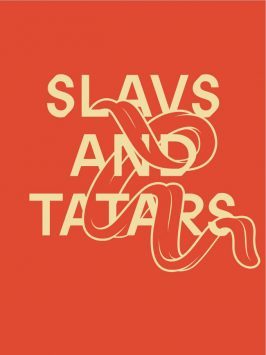
Slavs and Tatars: Mouth to Mouth
by David Joselit, Jorg Heiser, Slavs and Tatars, Susan Babaie
- Tytuł oryginalny
- Atomic Habits
- Język oryginału
- Angielski
- Liczba stron
- 320
- Wydawnictwo
- Avery
O tej książce
Defining an area ‘east of the former Berlin Wall and west of the Great Wall of China’ as their remit, Slavs and Tatars repeatedly creolize, craft and collide a political and imagined geography to topple our brittle notions of identity, language, and beliefs.Throughout their 10 year practice, the artist collective has turned to Turkic language politics, medieval advice literature, the relationship between Iran and Poland, and transliteration, to name but a few of their areas of research.A region sandwiched between empires (Russian, Byzantine, Persian, to name a few), ideologies (Communism and political Islam), not to mention the Abrahamic faiths, Eurasia becomes a foil to an understanding of ourselves as multiple subjectivities.The artists’ work (from sculptures to lecture performances, installations to publications) similarly overturn the traditional hierarchies of understanding, seeing, and listening. Slavs and Tatars aim to free knowledge from the Enlightenment confines of the mind.Accompanies the mid-career touring exhibition, Slavs and Tatars: Mouth to Mouth at Ujazdowski Castle Centre for Contemporary Art, Warsaw (Nov 2016 – Feb 2017); Pejman Foundation, Tehran (Apr 2017); Salt Galata, Istanbul (Jun 2017); CAC Vilnius (Sep 2017); Museum of Contemporary Art, Belgrade (Nov 2017); and Albertinum, Dresden (Winter 2017-2018).Slavs and Tatars’ art work in museum collections includes MoMA, New York, and Tate Modern, London. Their work has been exhibited at museums such as Centre Pompidou (Paris), Tate Modern (London), Hamburger Bahnhof (Berlin), and has been included in art festivals such as, Manifesta, and Berlin Biennale.
Więcej od David Joselit
Doug Aitken. Notes for New Religion
Henry Grunwald, Doug Aitken, Gijs van Tuyl, Jorg Heiser
Art and Theory of Post-1989 Central and Eastern Europe: A Critical Anthology
Igor Zabel, Boris Groys, Christian Rattemeyer, David Joselit, Kim Conaty, Claire Bishop, Artur Żmijewski, David Platzker, Ana Janevski, Bojana Cvejic, Cosmin Costinas, David Senior, Keti Chukhrov, Gediminas Urbonas, Nomeda Urbonas, Aldo Milohnić, Bojana Pejić, Nataša Petrešin-Bachelez, Ekaterina Degot, Boris Buden, Deimantas Narkevičius, Jelena Vesić, What, How & for Whom/WHW, Marina Gržinić, Lina Michelkevičė, Cristina Ricupero, Tomáš Pospiszyl, Sven Spieker, Irwin, Viktor Misiano, Margarita Tupitsyn, Michelle Elligott, Georg Schöllhammer, Octavian Esanu, Marius Babias, Andreas Broeckmann, Dan Perjovschi, Piotr Piotrowski, Juliet Kinchin, Zdenka Badovinac, Yevgeniy Fiks, Inke Arns, Vít Havránek, Eda Čufer, Slavs and Tatars, Maja Fowkes, Sanja Iveković, Edit András, Rastko Močnik, Karol Radziszewski, Reuben Fowkes, David Maljkovic, Ilya Budraitskis, Zbynek Baladran, Daniel Grúň, Branislav Dimitrijević, Klara Kemp-Welch, Zuzana Štefková, Alina Serban, Martina Pachmanová, Ondřej Chrobák, Andres Kurg, Eva Majewska, Katalin Ladik, Ovidiu Țichindeleanu, Ivana Bago, Jonas Valatkevičius, Magdalena Moskalewicz, Branislava Andjelković, Luchezar Boyadjiev, Meghan Forbes, Tímea Junghaus, Zofia Kulik, Václav Magid, Ewa Opałka, Bojana Piškur, Paulina Pobocha, Lýdia Pribišová, Oleksiy Radynski, Tamas St.Auby, Dmitry Vilensky, Raluca Voinea
2012 Busan Biennale: Busan Museum of Art, South Korea.: An article from: Artforum International
David Joselit
After Art
David Joselit