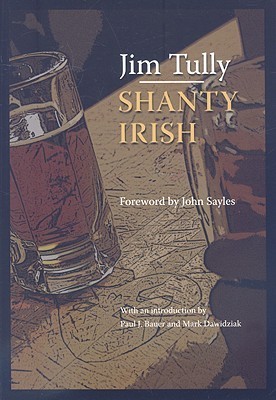
Shanty Irish
by John Sayles, Jim Tully
- Tytuł oryginalny
- Atomic Habits
- Język oryginału
- Angielski
- Liczba stron
- 320
- Wydawnictwo
- Avery
O tej książce
Memories of an Irish-American growing up log-shack poor in small-town Ohio “Shanty Irish is a window, cracked and soiled, into a time and a place and a people before the moving pictures became an American obsession, people who had to create their own dreams, invent their own stories, and find escape from hopeless lives in hard liquor or the cold comfort of a promised Hereafter.” ―from the foreword by John Sayles Jim Tully was an American writer who enjoyed critical acclaim and commercial success in the 1920s and ’30s. A former circus laborer, hobo, and professional boxer, his rags-to-riches career may qualify him as the greatest long shot in American literature. Following the death of his mother, Tully was sent from his home in St. Marys, Ohio, to an orphanage in Cincinnati. After his time at the orphanage, the young Tully spent six years as a vagabond, riding the rails and working for a small circus. He left the road and settled in Kent, Ohio, in 1907, working odd jobs while focusing on his new interest―writing. After getting a few pieces published in local papers, Tully returned to the road in 1912, eventually settling for good in Hollywood. He worked for Charlie Chaplin and later became one of the first reporters to cover Hollywood. His honest depictions of film stars and directors earned him the reputation as the most feared man in Hollywood. In addition to the celebrity pieces, Tully wrote numerous books, including Shanty Irish (1928). A hard-edged mixture of hilarious and heartbreaking memories, Tully’s autobiographical Shanty Irish digs deep into the soil of his native Ohio to show what life was like in the late nineteenth century for a poor Irish-American family. Within the covers of this acclaimed work, we meet the author’s father, also named Jim Tully, “a gorilla built” ditchdigger whose stooped shoulders carry “the inherited burdens of a thousand dead Irish peasants.” We meet his mother, Biddy, a “woman of imagination” who “had all the moods of April.” We meet his uncle, ruthless John Lawler, who was tried, convicted, and sentenced to fifteen years in the Ohio penitentiary for stealing horses. And we meet his grandfather, Old Hughie Tully, “born with the gift of words”―“capable of turning death into an Irish wake and pouring liquor down the throat of the corpse.” Old Hughie, “never without a tale to tell,” emerges as the most vividly drawn character in a book packed with unforgettable characters. Tully’s most deeply personal book, Shanty Irish had a profound impact on readers and other leading American writers of the 1920s. “Shanty Irish is a chunk of real life,” wrote Upton Sinclair. “It made me feel human and humble, which is good for anybody.” H. L. Mencken said, “ In Shanty Irish, it seems to me, he has gone far beyond any of his work of the past. The book is not only brilliantly realistic; it also has fine poetic quality.” Indeed, a book soaked in mud and whiskey, Shanty Irish is at turns brutal, sentimental, ironic, lyrical, humorous, and tragic.
Więcej od John Sayles
American Voices: A Collection of Documents, Speeches, Essays, Hymns, Poems, and Short Stories from American History
John Updike, Jane Smiley, Raymond Carver, Sandra Cisneros, Amy Tan, John Sayles, Charles Baxter, Stephanie Vaughn, Dennis McFarland, Andrea Lee, Judith Rossner, Christopher Tilghman, Alice Adams, Andrea Barrett, Harriet Doerr, Frank Conroy, Laurie Colwin, Joyce
Florida Stories: Tales from the Tropics
Ernest Hemingway, Joy Williams, Elmore Leonard, Nathaniel Hawthorne, Damon Runyon, Isaac Bashevis Singer, Joan Didion, Zora Neale Hurston, Elizabeth Bishop, Alison Lurie, Dave Barry, Tennessee Williams, Stephen Crane, John D. MacDonald, Wallace Stevens, John Sayles, John James Audubon, William Bartram, John Miller
Santa Barbara Stories
Nicholson Baker, John Sayles, Ross Macdonald, Gayle Lynds, Wallace Stegner, T.C. Boyle, Dennis Lynds, Catherine Ryan Hyde, Marvin Mudrick, Steven Gilbar
Sayles on Sayles
John Sayles, Gavin Smith