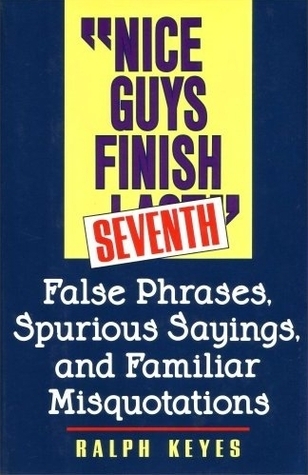
"Nice guys finish seventh": False phrases, spurious sayings, and familiar misquotations
by Ralph Keyes
- Tytuł oryginalny
- Atomic Habits
- Język oryginału
- Angielski
- Liczba stron
- 320
- Wydawnictwo
- Avery
O tej książce
Leo Durocher is best remembered for saying, "Nice guys finish last." He never said it. What the Brooklyn Dodgers' manager did say, before a 1946 game with the New York Giants, was: "The nice guys are all over there. In seventh place." Durocher's words lacked pop. Sportswriters perked them up, and gave America one of its most familiar misquotations. Ralph Keyes points out in "Nice Guys Finish Seventh" that many of our best-known sayings, phrases, and quotations are inaccurate, misattributed, or both. During two decades of research, he discovered that: "Any man who hates dogs and children can't be all bad" was said about W. C. Fields, not by him; "Winning isn't everything, it's the only thing" was the slogan of UCLA coach Red Sanders, not Vince Lombardi; "The opera ain't over 'til the fat lady sings" was adapted from an old saying: "Church ain't out 'til the fat lady sings"; and Winston Churchill did not originate the phrase "iron curtain," and never said, "blood, sweat and tears." Hundreds of such examples illustrate Keyes's Immutable Law of Misquotation: Misquotes drive out real quotes. "Certain things demand to be said," he writes, "said in a certain way, and by the right person. Whether such comments are accurate is beside the point." Keyes confirms that William Tecumseh Sherman didn't say, "War is hell." Nor did he vow, "If nominated, I will not run. If elected, I will not serve." According to Keyes, such words voice observations we want made. Freud may never have said, "Sometimes a cigar is just a cigar," for example, but we certainly wish he had. For a misquote to become familiar it must come from a well-known mouth. Take "You can't trust anyone over thirty." Abbie Hoffman, right? Or was it Jerry Rubin? Mario Salvo? Mark Rudd? All have been given credit for this sixties catchphrase. Keyes discovered that its real originator was a student named Jack Weinberg. Remember him? Few do. That's why Weinberg's words were assigned to better-known mouths. Keyes calls
Więcej od Ralph Keyes
Antioch Review: Fall 2012
Bruce Jay Friedman, Ariel Dorfman, Jeffrey Meyers, William Kerrigan, Ralph Keyes, John Taylor, Jacqueline Osherow, Peter N. Carroll, Robert S. Fogarty, Emily Rosko, Andrew Grace, Ed Allen, Robin Romm, Mark Rubin, Ernst Stadler, Sigman Byrd, Tomasz Kamusella
Chancing It: Why We Take Risks
Ralph Keyes
Euphemania: Our Love Affair with Euphemisms
Ralph Keyes
I Love it When You Talk Retro: Hoochie Coochie, Double Whammy, Drop a Dime, and the Forgotten Origins of American Speech
Ralph Keyes