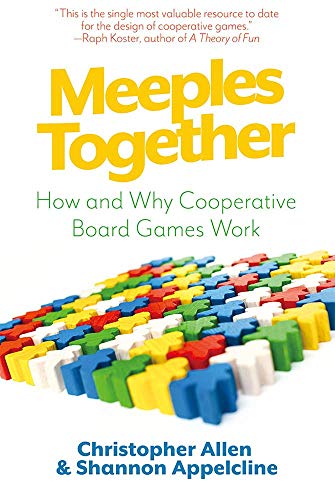
Meeples Together: How and Why Cooperative Board Games Work
by Keith Curtis, Christopher Allen, Shannon Appelcline, Matt Leacock
- Tytuł oryginalny
- Atomic Habits
- Język oryginału
- Angielski
- Liczba stron
- 320
- Wydawnictwo
- Avery
O tej książce
How and Why Cooperative Games WorkThis is the authoritative source on cooperative board games and card games for gamers, aficionados, critics, and designers, featuring a deep dive into co-op gaming’s titles, mechanics, theory, and frontiers.You are on an epic mission to combat global plague. Or you are seeking out werewolves in an isolated village. Houses are on fire, islands are sinking, and enemy androids have infiltrated the fleet.You can’t succeed alone — and victory requires more than understanding your teammates. You need to know the game.Join experts Christopher Allen and Shannon Appelcline as they examine not only how cooperative board games work, but why . With more than 150 enlightening images showing principles and mechanisms of play in action, this book helps you see your favorite cooperative board games in new ways. Together, we look deep into the machines of great games to reveal how they work — and how we play.Whether you want to play cooperative games better, discover your next favorite game, or design the world’s next favorite, Meeples Together is for you.Table of ContentsForeword by Matt Leacock (designer of Pandemic )Chapter 1: The Basics of CooperationPart The Spectrum of Cooperative GamingChapter 2: Styles of CompetitionCase TerraChapter 3: Styles of TeamworkCase Contract BridgeCase One Night Ultimate WerewolfChapter 4: Styles of CooperationCase PandemicCase Forbidden IslandCase Forbidden DesertPart The Mechanics of Cooperative GamesChapter 5: Cooperative SystemsCase Flash Fire RescueChapter 6: Challenge SystemsCase Robinson Crusoe — Adventures on the Cursed IslandChapter 7: Players Facing ChallengesCase Shadows over CamelotCase Battlestar The Board GameChapter 8: Players Undertaking TasksCase Arkham Horror 2eChapter 9: Adventure SystemsCase Mansions of Madness 2ePart The Theory of Cooperative GamesChapter 10: A Theory of Cooperative GamingCase Space AlertChapter 11: A Theory of Challenge DesignCase Ghost StoriesChapter 12: When Games Go WrongCase D-Day DicePart Cooperative FrontiersChapter 13: The Psychology of Cooperative GamingCase HanabiChapter 14: Assembling the PuzzleCase SOS TitanicAppendicesAppendix The Basics of Game DesignAppendix Game Design DilemmasAppendix Game Design TypesAppendix Game Design & Social TheoriesAppendix Cooperative & Teamwork Game Synopses & Reviews
Więcej od Keith Curtis
An Accidental Plan
Keith Curtis
Chroniques de Westeros
John Hay, David Nash, James Kiley, Keith Curtis, Mark Simmons, John Newman, Michelle Lyons-McFarland, Slawomir Maniak, Lee Hammock, Britt Martin, Brian E. Kirby, Noah Bradley, Brett Rebischke-Smith, Christopher Reach
Embedded Multitasking
Keith Curtis
From Management Goal-Setting to Organizational Results: Transforming Strategies Into Action
Keith Curtis