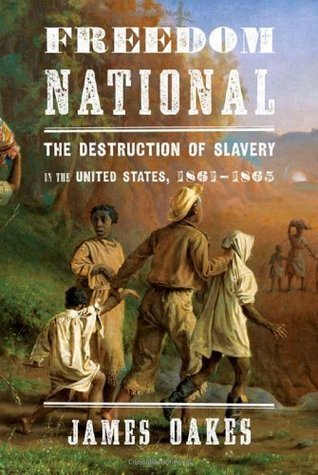
Freedom National: The Destruction of Slavery in the United States, 1861-1865
by James Oakes
- Tytuł oryginalny
- Atomic Habits
- Język oryginału
- Angielski
- Liczba stron
- 320
- Wydawnictwo
- Avery
O tej książce
A powerful history of emancipation that reshapes our understanding of Lincoln, the Civil War, and the end of American slavery.Freedom National is a groundbreaking history of emancipation that joins the political initiatives of Lincoln and the Republicans in Congress with the courageous actions of Union soldiers and runaway slaves in the South. It shatters the widespread conviction that the Civil War was first and foremost a war to restore the Union and only gradually, when it became a military necessity, a war to end slavery. These two aims—"Liberty and Union, one and inseparable"—were intertwined in Republican policy from the very start of the war.By summer 1861 the federal government invoked military authority to begin freeing slaves, immediately and without slaveholder compensation, as they fled to Union lines in the disloyal South. In the loyal Border States the Republicans tried coaxing officials into gradual abolition with promises of compensation and the colonization abroad of freed blacks. James Oakes shows that Lincoln’s landmark 1863 proclamation marked neither the beginning nor the end of emancipation: it triggered a more aggressive phase of military emancipation, sending Union soldiers onto plantations to entice slaves away and enlist the men in the army. But slavery proved deeply entrenched, with slaveholders determined to re-enslave freedmen left behind the shifting Union lines. Lincoln feared that the war could end in Union victory with slavery still intact. The Thirteenth Amendment that so succinctly abolished slavery was no formality: it was the final act in a saga of immense war, social upheaval, and determined political leadership.Fresh and compelling, this magisterial history offers a new understanding of the death of slavery and the rebirth of a nation.8 pages illustrations
Więcej od James Oakes
Beyond Freedom: Disrupting the History of Emancipation
David W. Blight, Chandra Manning, Eric Foner, Richard Newman, Greg Downs, James Oakes, Thavolia Glymph, Brenda E. Stevenson, Hannah Rosen, Kate Masur, Carole Emberton, Justin Behrend, Susan O'Donovan
Knowing Him by Heart: African Americans on Abraham Lincoln
Malcolm X, Barack Obama, Frederick Douglass, Paul Laurence Dunbar, Langston Hughes, Alice Dunbar-Nelson, Charles W. Chesnutt, Edna Greene Medford, Michael Burlingame, Gwendolyn Brooks, George Washington, W.E.B. Du Bois, Martin Luther King Jr., James Weldon Johnson, James Oakes, Ida B. Wells-Barnett, Booker T. Washington, John Hope Franklin, Julius Lester, Matthew Pinsker, Claude McKay, Richard Carwardine, Jabez P Campbell, George B Vashon, Osborne P Anderson, Elizabeth Keckley, William A Sinclair, William Pickens, John M Gandy, Richard W Gadsden, Eugene Gordon, Jackie Robinson, Charles H Wesley, John H Sengstacke, Edward M Thomas, Alexander T Augusta, Amos G Beman, S.W. Chase, Martin Delany, Angeline R Demby, H Cordelia, Archibald Henry Grimké, Etta M. T. Cottin, Robert R Wright Sr, Edward A Johnson, Walter White, Thurgood Marshall, Lerone Bennett Jr, Philip A Bell, James Smith, John Willis Menard, John H Morgan, Don Carlos Rutter, Thomas N.C Liverpool, Mary Church Terrell, Reverdy C. Ransom, Georgia Douglas Johnson, Lamar Perkins, Aaron H Payne, Roy Wilkins, Daisy Bates, Frances Ellen Watkins Harper, Sojourner Truth, Clarence Thomas, Harriet Tubman, Mary McLeod Bethune, Vincent Harding, Douglas L. Wilson, Rodney O. Davis, Kelly Miller, St. Clair Drake, Henry Highland Garnet, Ella Baker, Carter G. Woodson, Mary Frances Berry, Benjamin Arthur Quarles, John Proctor, Arvarh E. Strickland, Robert Hamilton, William H. Lewis, Jacob Thomas, Thomas Hamilton, Jeremiah Asher, Henry Johnson, Henry Lee Moon, Timothy Thomas Fortune, Henry McNeal Turner, John Mercer Langston, Cps, Grace Evans, Hannah Johnson, Elizabeth Thomas, Josephine Silone Yates, Annie Davis, Robert Purvis, African Civilization Society, Fred Lee Hord, Edith Sampson, William E Lilly, EWS Hammond