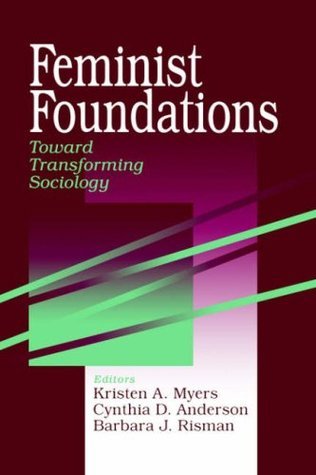
Feminist Foundations: Toward Transforming Sociology
by Jacqueline Johnson, Rosabeth Moss Kanter, Patricia Hill Collins, Barrie Thorne, Maxine Baca Zinn, Irene Padavic, Barbara F. Reskin, Nancy Whittier, Christine E. Bose, Judith Stacey, Verta Taylor, Leila J. Rupp, Janet Saltzman Chafetz, Patricia Yancey Martin, Janet Lever, Joan Acker, Cynthia Fuchs Epstein, Don H. Zimmerman, Raewyn W. Connell, Joan Huber, Candace West, Esther Ngan-Ling Chow, Jessie Bernard, Doris Wilkinson, Rose Laub Coser, Toni M. Calasanti, Kristen A. Myers, Alice Rossi, Rachel A. Rosenfeld, Douglas Mason-Schrock, Bonnie Thorton Dill
- Tytuł oryginalny
- Atomic Habits
- Język oryginału
- Angielski
- Liczba stron
- 320
- Wydawnictwo
- Avery
O tej książce
There can be no doubt that feminism, and its influence on the academy, has wrought enormous changes on the social sciences in general and sociology in particular. This edited volume is an outgrowth of a discussion that began on the Sociologists for Women in Society Listserve, in which participants were asked to talk about key pieces in feminist scholarship that had particularly influenced their sociological thinking. Editors Kristen A. Myers, Cynthia D. Anderson, and Barbara J. Risman have chosen articles that fall into what they consider the intellectual genres that compose feminist sociology. This collection differs from others because the editors avoid organizing material by substantive specialty areas (i.e., family, race and ethnicity, criminology, or methods). Their vision instead sees sociology as an integrated discipline, where feminist contributions have systematically influenced the shape of the whole by similarly influencing the distinct parts. In addition to simply compiling a comprehensive list of important articles from the last two decades, the editors have invited major feminist scholars to comment and reflect on the articles in each section of the book. These reflections help provide the historical and social context in which feminist scholarship has taken place. This book will be of obvious appeal to feminist scholars and gender sociologists. Yet, as feminist thought rightfully takes its place away from the margins and toward the center of the discipline, this book stands as a rich and useful resource for any contemporary theory course.