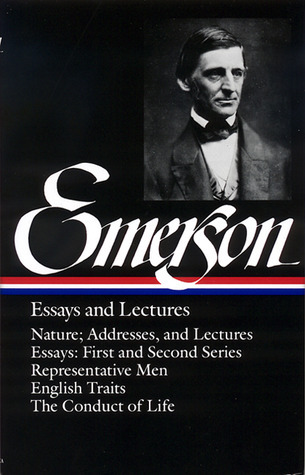
Essays and Lectures
- Tytuł oryginalny
- Atomic Habits
- Język oryginału
- Angielski
- Liczba stron
- 320
- Wydawnictwo
- Avery
O tej książce
This first Library of America volume of Emerson’s writing covers the most productive period of his life, 1832–1860. Our most eloquent champion of individualism, Emerson acknowledges at the same time the countervailing pressures of society in American life. Even as he extols what he called “the great and crescive self,” he dramatizes and records its vicissitudes.Here are the indispensable and most renowned works, including “The American Scholar” (“our intellectual Declaration of Independence,” as Oliver Wendell Holmes called it), “The Divinity School Address,” considered atheistic by many of his listeners, the summons to “Self-Reliance,” along with the more embattled realizations of “Circles” and, especially, “Experience.” Here, too, are his wide-ranging portraits of Montaigne, Shakespeare, and other “representative men,” and his astute observations on the habits, lives, and prospects of the English and American people.This volume includes Emerson’s well-known Nature; Addresses, and Lectures (1849), his Essays: First Series (1841) and Essays: Second Series (1844), plus Representative Men (1850), English Traits (1856), and his later book of essays, The Conduct of Life (1860). These are the works that established Emerson’s colossal reputation in America and found him admirers abroad as diverse as Carlyle, Nietzsche, and Proust.Emerson’s enduring power is apparent everywhere in American literature: in those, like Whitman and some of the major twentieth-century poets, who seek to corroborate his vision, and among those, like Hawthorne and Melville, who questioned, qualified, and struggled with it. Emerson’s vision reverberates also in the tradition of American philosophy, notably in the writings of William James and John Dewey, in the works of his European admirers, such as Nietzsche, and in the avant-garde theorists of our own day who write on the nature and function of language. The reasons for Emerson’s durability will be obvious to any reader who follows the exhilarating, exploratory movements of his mind in this uniquely full gathering of his work.Not merely another selection of his essays, this volume includes all his major books in their rich entirety. No other volume conveys so comprehensively the exhilaration and exploratory energy of perhaps America’s greatest writer.
Więcej od Ralph Waldo Emerson
A Year with Emerson
Ralph Waldo Emerson, Richard L. Grossman
American Poetry: The Nineteenth Century, Vol. 1: Freneau to Whitman
Edgar Allan Poe, Abraham Lincoln, Nathaniel Hawthorne, Henry Wadsworth Longfellow, Edmund Hamilton Sears, John Greenleaf Whittier, Clement Clarke Moore, Walt Whitman, Henry David Thoreau, Ralph Waldo Emerson, John Hollander, James Russell Lowell, Washington Allston, William Cullen Bryant, Edward Coote Pinkney, Thomas Cole, John Neal, Sarah Helen Whitman, Oliver Wendell Holmes Sr., Cornelius Mathews, James Gates Percival, Fanny Kemble, William Ellery Channing, Samuel Woodworth, Joseph Rodman Drake, Daniel Decatur Emmett, John Quincy Adams, Carlos Wilcox, Charles Timothy Brooks, Philip Freneau, Richard Henry Dana Jr., Samuel Henry Dickson, Julia Ward Howe, Francis Scott Key, James Kirke Paulding, Maria Gowen Brooks, Lydia Maria Child, William Gilmore Simms, Christopher Pearse Cranch, Josiah D. Canning, Joel Barlow, Fitz-Greene Halleck, George Pope Morris, Thomas Holley Chivers, Philip Pendleton Cooke, Thomas Dunn English, John Pierpont, John Howard Payne, Jones Very, J.G. Holland, Manoah Bodman, Richard Henry Wilde, George Moses Horton, Nathaniel Parker Willis, Margaret Fuller, L.H. Sigourney, Amos Bronson Alcott, Epes Sargent, William Wetmore Story
Antislavery Writings
Ralph Waldo Emerson
Art
Charles William Eliot, Ralph Waldo Emerson