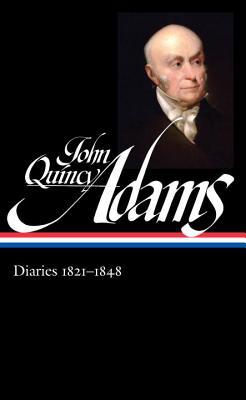
Diaries 1821-1848: The Monroe Doctrine / Henry Clay and the Election of 1824 / Presidency / Father’s Death and Son’s Suicide / The Age of Jackson / House of Representatives / Amistad Case / Triumph over the Gag Rule
- Tytuł oryginalny
- Atomic Habits
- Język oryginału
- Angielski
- Liczba stron
- 320
- Wydawnictwo
- Avery
O tej książce
For the 250th anniversary of Adams’s birth, Library of America and historian David Waldstreicher have prepared a two-volume reader’s edition of his monumental diary, presenting selections based for the first time on the original manuscripts and restoring personal and revealing passages suppressed in earlier editions.As this second volume opens Adams, as secretary of state, is the leading figure in James Monroe’s cabinet, a fractious group whose members jockey to be the next president. This political intrigue, described with gripping immediacy in the diary, culminates in Adams’s election to the presidency by the House of Representatives after a deadlocked four-way contest. Even as Adams takes the oath of office, rivals Henry Clay, his secretary of state, John C. Calhoun, his vice president, and an embittered Andrew Jackson eye the next election in 1828. The diary records Adams’s frustration as his far-sighted agenda for national unification and internal improvement is threatened by this internecine political factionalism, as well as his revulsion at the advent of the “unprincipled absurdities” of Jacksonian democracy: “My hopes of the long continuance of this Union are extinct — The people must go the way of all the world.”After a short-lived post-presidential retirement, during which he and his wife Louisa Catherine endure the apparent suicide of their eldest son, Adams returns to public service as a congressman from Massachusetts, without question the most extraordinary second act in American political history. In his final seventeen years, Adams leads efforts to resist the extension of slavery and to end the notorious “gag rule” that stifles debate on the issue in Congress, earning the sobriquet Old Man Eloquent. In 1841, he further burnishes his antislavery reputation by successfully defending the African mutineers of the slave ship Amistad before the Supreme Court, a dramatic manifestation of his life-long commitment to liberty and the rule of law. The edition concludes with Adams’s final entry, recorded on February 20, 1848, the day before he suffered a fatal stroke at his congressional desk.Throughout, the diary brims with brilliant, sometimes acerbic portraits of an astonishing range of American statesmen, from Thomas Jefferson and James Madison to Stephen A. Douglas and Andrew Johnson.
Więcej od John Quincy Adams
American Antislavery Writings: Colonial Beginnings to Emancipation
Benjamin Franklin, Thomas Paine, Abraham Lincoln, Frederick Douglass, Emily Dickinson, Harriet Beecher Stowe, Louisa May Alcott, Henry Wadsworth Longfellow, John Greenleaf Whittier, Walt Whitman, Henry David Thoreau, Herman Melville, Ralph Waldo Emerson, James Russell Lowell, Olaudah Equiano, William Cullen Bryant, John Townsend Trowbridge, George Washington, Patrick Henry, William Lloyd Garrison, John Neal, William Ellery Channing, John Quincy Adams, Philip Freneau, Julia Ward Howe, Lydia Maria Child, Joel Barlow, John Pierpont, George Moses Horton, L.H. Sigourney, Benjamin Rush, Sarah Moore Grimké, Horace Mann, Rufus King, Lucretia Mott, James G. Basker, Thomas Wentworth Higginson, Jonathan Edwards, Solomon Northup, Wendell Phillips, Elizabeth Cady Stanton, Sojourner Truth, John Woolman, John Jay, Noah Webster, Harriet Tubman, Susanna Rowson, James Williams, Henry Highland Garnet, Henry Bibb, William Wells Brown, Austin Steward, Eliza Lee Cabot Follen, Horace Greeley, Samuel Sewall, Lunsford Lane, Theodore Dwight Weld, Moses Roper, John Trumbull, Harry Thomas, James McCune Smith, James Gillespie Birney, David Humphreys, Josiah Henson, Henry Box Brown, Jupiter Hammon, Thomas Mayne Reid, Martha Griffith Browne, Anthony Benezet, William H. Seward, Elizabeth Margaret Chandler, Henry Ward Beecher, St. George Tucker, Arthur Lee, Absalom Jones, Thomas Branagan, Gerrit Smith, Timothy Dwight, George Keith, Samuel Hopkins, Jane Dunlap, Hannah Townsend, Edmund Quincy, George Bourne, Maria Weston Chapman, Mary Hayden Green Pike, Prince Saunders, Jermain Wesley Loguen, Lemuel Haynes, Annie Parker, Elhanan Winchester, Ezra Stiles, Joseph Sansom, Benjamin Banneker
American Poetry: The Nineteenth Century, Vol. 1: Freneau to Whitman
Edgar Allan Poe, Abraham Lincoln, Nathaniel Hawthorne, Henry Wadsworth Longfellow, Edmund Hamilton Sears, John Greenleaf Whittier, Clement Clarke Moore, Walt Whitman, Henry David Thoreau, Ralph Waldo Emerson, John Hollander, James Russell Lowell, Washington Allston, William Cullen Bryant, Edward Coote Pinkney, Thomas Cole, John Neal, Sarah Helen Whitman, Oliver Wendell Holmes Sr., Cornelius Mathews, James Gates Percival, Fanny Kemble, William Ellery Channing, Samuel Woodworth, Joseph Rodman Drake, Daniel Decatur Emmett, John Quincy Adams, Carlos Wilcox, Charles Timothy Brooks, Philip Freneau, Richard Henry Dana Jr., Samuel Henry Dickson, Julia Ward Howe, Francis Scott Key, James Kirke Paulding, Maria Gowen Brooks, Lydia Maria Child, William Gilmore Simms, Christopher Pearse Cranch, Josiah D. Canning, Joel Barlow, Fitz-Greene Halleck, George Pope Morris, Thomas Holley Chivers, Philip Pendleton Cooke, Thomas Dunn English, John Pierpont, John Howard Payne, Jones Very, J.G. Holland, Manoah Bodman, Richard Henry Wilde, George Moses Horton, Nathaniel Parker Willis, Margaret Fuller, L.H. Sigourney, Amos Bronson Alcott, Epes Sargent, William Wetmore Story
Diaries 1779-1821: Boyhood in Europe / Harvard / The French Revolution / The Age of Jefferson / Napoleon’s Invasion of Russia / The War of 1812 and the Treaty of Ghent / Minister to Great Britain / The Missouri Compromise
John Quincy Adams
Familiar Letters of John Adams and His Wife Abigail Adams
Abigail Adams, John Quincy Adams, Charles Francis Adams