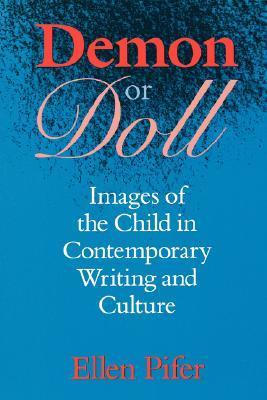
Demon or Doll: Images of the Child in Contemporary Writing and Culture
by Ellen Pifer
- Tytuł oryginalny
- Atomic Habits
- Język oryginału
- Angielski
- Liczba stron
- 320
- Wydawnictwo
- Avery
O tej książce
From the shootings at Columbine High School to the JonBenet Ramsey murder to the sentencing of "killer kids," today's media cannot decide if children are objects of fear or in need of protection. Our culture's deep-seated ambivalence toward its young is reflected in a fascinating array of recent fiction that exposes society's collective fantasies and fears. Demon or Doll investigates the ambiguous, contradictory ways childhood has been formulated in the twentieth century and the resulting ambivalence reflected in contemporary fiction. Grounding her exploration in a discussion of traditional constructions of childhood and the influence of the Romantics, Ellen Pifer shows how Dickens translated the Romantic idyll of original innocence into poignant images of "poor children," abused or abandoned by a harsh, increasingly mechanical society. At the turn of the twentieth century, Henry James created provocative images of childhood that anticipated the contemporary, post-Freudian child. Pifer engages a diverse and distinguished body of work by a global range of authors, addressing in each chapter a novel or cluster of novels in which the child's image serves as a nexus for investigating literary and cultural issues. The theories and observations of social historians, psychologists, and cultural critics--from Philippe Ariès to Raymond Williams, Freud to Foucault--clarify the significance of the child's created image. Novels by William Golding, Doris Lessing, Milan Kundera, Toni Morrison, Salman Rushdie, and Jerzy Kosinski bring readers face to face with shattered, often grotesque images of the child. But several of postwar fiction's most experimental writers, including Vladimir Nabokov, Don DeLillo, and Ian McEwan, create texts that render surprising faith in original innocence. Whether the contemporary image of childhood appears intact or fractured, wholesome or horrifying, its many facets create a mirror in which we seek glimpses of our elusive, original selves.
Więcej od Ellen Pifer
"Two different speeches": Mystery and knowledge in Mr. Sammler's planet
Ellen Pifer
Critical Essays on John Fowles
Ellen Pifer
Dictionary of Literary Biography, Volume 14: British Novelists Since 1960
Lorna Sage, Cairns Craig, Randall Stevenson, Colin Greenland, David W. Madden, Morton P. Levitt, John Fletcher, Ellen Pifer, Peter Conradi, Mary Rose Callaghan, Malcolm Bradbury, Geoffrey Aggeler, Melvin J. Friedman, Patricia Craig, George O'Brien, Malcolm Page, Paul Binding, Elizabeth Allen, Sarah Turvey, Thomas O. Calhoun, Thomas J. Cousineau, Caryn McTighe Musil, Harriet Blodgett, Priscilla Martin, June Sturrock, Patrick Lyons, G.M. Hyde, Anne Fisher, Philip Flynn, Simon Edwards, Fleda Brown, Catherine Wells-Cole, S.J. Newman, Jay L. Hailo, Frank Crotzer, Cathleen Donnelly, Kim D. Heine, Georgia L. Lambert, Marla Levy, Barbara C. Millard, Rosemarie Mroz, Theresa M. Peter, Gerda Seaman, Sibyl L. Severance, Thomas J. Starr, Gerald Steel, Virginia Briggs, Gerard Werson, T. Winnifrith, Kathleen Fullbrook, Linda Canon
Nabokov and the Novel
Ellen Pifer