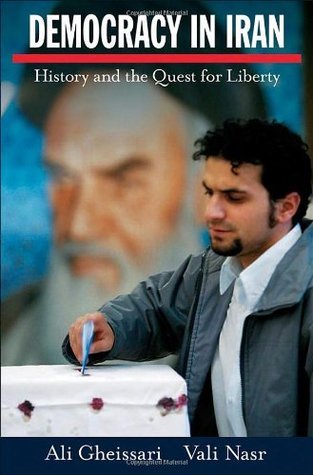
Democracy in Iran: History and the Quest for Liberty
- Tytuł oryginalny
- Atomic Habits
- Język oryginału
- Angielski
- Liczba stron
- 320
- Wydawnictwo
- Avery
O tej książce
Today Iran is once again in the headlines. Reputed to be developing nuclear weapons, the future of Iraq's next-door neighbor is a matter of grave concern both for the stability of the region and for the safety of the global community. President George W. Bush labeled it part of the "Axis of Evil," and rails against the country's authoritarian leadership. Yet as Bush trumpets the spread of democracy throughout the Middle East, few note that Iran has one of the longest-running experiences with democracy in the region.In this book, Ali Gheissari and Vali Nasr look at the political history of Iran in the modern era, and offer an in-depth analysis of the prospects for democracy to flourish there. After having produced the only successful Islamist challenge to the state, a revolution, and an Islamic Republic, Iran is now poised to produce a genuine and indigenous democratic movement in the Muslim world. Democracy in Iran is neither a sudden development nor a western import, Gheissari and Nasr argue. The concept of democracy in Iran today may appear to be a reaction to authoritarianism, but it is an old idea with a complex history, one that is tightly interwoven with the main forces that have shaped Iranian society and politics, institutions, identities, and interests. Indeed, the demand for democracy first surfaced in Iran a century ago at the end of the Qajar period, and helped produce Iran's surprisingly liberal first constitution in 1906. Gheissari and Nasr seek to understand why democracy failed togrow roots and lost ground to an autocratic Iranian state. Why was democracy absent from the ideological debates of the 1960s and 1970s? Most important, why has it now become a powerful social, political, and intellectual force? How have modernization, social change, economic growth, and the experience of the revolution converged to make this possible?
Więcej od Vali Nasr
Blind Spot: America's Response to Radicalism in the Middle East
Vali Nasr, Shadi Hamid, Peter Feaver, Richard Fontaine, Ryan Crocker, David Ignatius, Jared Cohen, Brent Scowcroft, Joseph S. Nye Jr., Bernard Haykel, Sarah Sewall, Philip D. Zelikow, Michèle Flournoy, Dov Zakheim, R. Nicholas Burns, William McCants, Graeme Wood, Frances Townsend, James E. Cartwright, Tom Pritzker, Farah Pandith
Can the World Tolerate an Iran with Nuclear Weapons?
Charles Krauthammer, Fareed Zakaria, Rudyard Griffiths, Vali Nasr, Amos Yadlin
Changing Course: A New Direction for U.S. Relations with the Muslim World
Stephen R. Covey, Vali Nasr, Richard Armitage, Madeleine K. Albright, Ingrid Mattson, Jessica Stern, Dennis Ross, Paul Brest, Robert Lifton, John Marks, Richard Land, Marc Gopin, Mustapha Tlili, Dalia Mogahed, Derek Kirkland, Susan Collin Marks, Consensus Building Institute, Search for Common Ground
Expectation of the Millennium: Shi'Ism in History
Seyyed Hossein Nasr, Vali Nasr, Hamid Dabashi