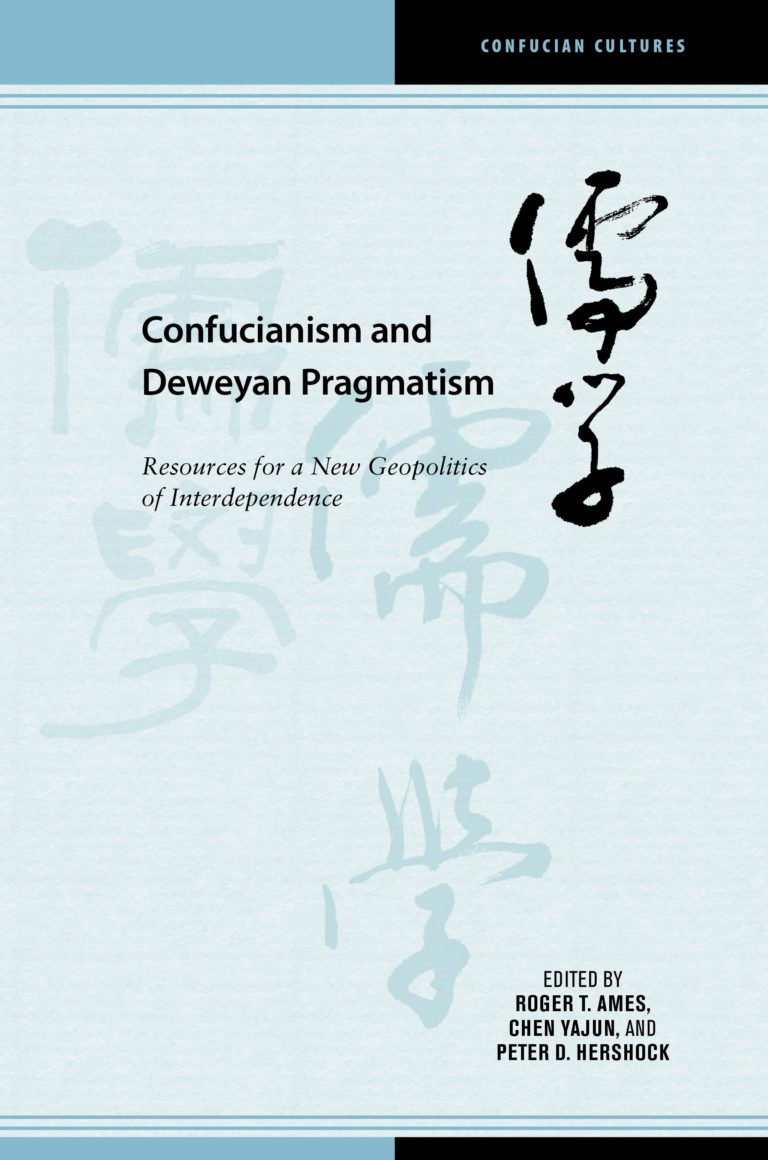
Confucianism and Deweyan Pragmatism: Resources for a New Geopolitics of Interdependence
by Roger T. Ames, Richard J. Bernstein, Sor-Hoon Tan, Viren Murthy, Judith M. Green, Barry Allen, Carlin Romano, Jia Chen, Guorong Yang, Jim Behuniak, Matthew A Foust, Leonard J Waks
- Tytuł oryginalny
- Atomic Habits
- Język oryginału
- Angielski
- Liczba stron
- 320
- Wydawnictwo
- Avery
O tej książce
Over the past generation, the rise of East Asia and especially China has brought about a sea change in the economic and political world order. At the same time, global warming, environmental degradation, food and water shortages, population explosion, and income inequities have created a perfect storm that threatens the very survival of humanity. It is clear now that the Westphalian model of individual sovereign states seeking their own self-interest will not be able to respond effectively to this win-win or lose-lose crisis. In this volume, a cadre of distinguished scholars comes together to reflect on Confucianism and Deweyan pragmatism as possible resources for a new geopolitics that begins from an ontology of interdependence and recognizes the irreducibly ecological nature of the human experience at every level.Both Confucian and Deweyan traditions emphasize the primacy of experience, the importance of vital relationality, and the moral roots of good governance. The potential benefits of conceptually blending the two are many. Indeed, the contemporary Chinese philosopher Tang Junyi provides us with a cosmological understanding of the "idea" of Confucianism that, in parallel to Dewey's "idea" of democracy, can enable us to anticipate the core values, if not the specific contours, of a "Confucian democracy." Just as Dewey's "idea" of democracy is his vision of the flourishing communal life made possible by the contributions of the uniquely distinguished persons that constitute it, Tang Junyi's Confucianism is a pragmatic naturalism directed at achieving the most highly integrated cultural, moral, and spiritual growth for the individual-in-community. In both, we find an affirmation of communal harmony as a process "starting here and going there" through which those involved learn together to do ordinary things in extraordinary ways. Just such a cosmological understanding of democracy is one way of describing what will be needed to address the many predicaments characterizing the environmental, cultural, socioeconomic, and political dynamics of the twenty-first century.
Więcej od Roger T. Ames
Hannah Arendt Revisited. 'Eichmann in Jerusalem' und die Folgen
Anthony Grafton, Seyla Benhabib, Avishai Margalit, Annette Wieviorka, Amos Elon, Richard J. Bernstein, Moishe Postone, Dan Diner, Norbert Frei, Stephane Moses, Gabriel Motzkin
Political Theory, Vol. 15
Richard Rorty, Richard J. Bernstein, Sheldon S. Wolin, Claus Offe, Bruce Jennings, John R. Wallach, W. R. Newell
Richard J. Bernstein and the Expansion of American Philosophy: Thinking the Plural
Richard J. Bernstein, George Yancy, Edward S. Casey, Espen Hammer, Katie Terezakis, Michael Weinman, Christopher P. Long, Rocio Zambrana, Marcia Morgan, Karen Ng, Brendan Hogan, Lawrence Marcelle, Lauren Barthold
Beyond the Nation-State: From Geopolitical Discourse to Civilizational Dialogues
Roger T. Ames, Peter D. Hershock, Sor-Hoon Tan, Dr. Krishan Kumar, Dr. Cheng Hong, Dr. Inho Choi, Dr. Emmanuel Desfourneaux, Dr. Yong Li, Dr. Lorenzo Marsili, Dr. Martin Powers, Jana Rošker, Dr. Dingxin Zhao, Dr. Yiqun Zhou