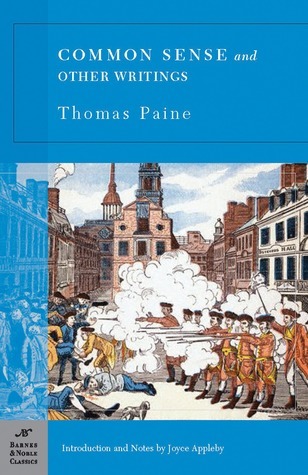
Common Sense and Other Writings
by Thomas Paine
- Tytuł oryginalny
- Atomic Habits
- Język oryginału
- Angielski
- Liczba stron
- 320
- Wydawnictwo
- Avery
O tej książce
Introduction and Notes by Joyce ApplebyThough he didn't emigrate from England to the colonies until 1774, just a few months before the Revolutionary War began, Thomas Paine had an enormous impact on that war & the new nation that emerged from it. Common Sense, the instantly popular pamphlet he published in January 1776, argued that the goal of the struggle against the British should be not simply tax reform, as many were calling for, but complete independence. His rousing, radical voice was balanced by the equally independence-minded but more measured tones of Thomas Jefferson, who wrote the Declaration of Independence later that year. In later works, such as The Rights of Man, The Age of Reason, & other selections included in this volume, he proved himself a visionary moralist centuries ahead of his time. He believed that every human has the natural right to life's necessities & that government's role should be to provide for those in dire need. An impassioned opponent of all forms of slavery, he understood that no one in poverty is truly free--a lesson still to be learned by many of our leaders today.
Więcej od Thomas Paine
America: A Concise History [with Common Sense + Era of Franklin D. Roosevelt]
Thomas Paine, James A. Henretta, David Brody, Lynn Dumenil, Richard Polenberg
America: A Concise History, Vol. 1. and, Common Sense and Related Writings; and, William Lloyd Garrison and the Fight Against Slavery; and, Envisioning America
Thomas Paine, James A. Henretta, Peter C. Mancall, William E. Cain, William Lloyd Garrison, Thomas P. Slaughter
Citing Atheists: Quotes of Agnosticism, Non-Theism, Skepticism, Irreligion, Free Thought, and Philosophy
Thomas Paine, Richard Dawkins, Sam Harris, Mark Twain, Christopher Hitchens, Robert G. Ingersoll, Carl Sagan, Steve Dustcircle, Baruch Spinoza, Paul Kurtz
Common Sense & Pearl Harbor and the Coming of the Pacific War & How Did American Slavery Begin?
Thomas Paine, Thomas P. Slaughter, Edward Countryman, Akira Iriye