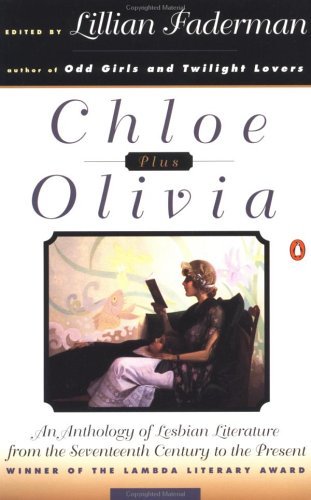
Chloe Plus Olivia: An Anthology of Lesbian Literature from the Seventeenth Century to the Present
by Emily Dickinson, Mary Eleanor Wilkins Freeman, Willa Cather, Christina Rossetti, Virginia Woolf, Rita Mae Brown, Anaïs Nin, Sigmund Freud, Katherine Mansfield, Carson McCullers, Sarah Orne Jewett, Jewelle Gomez, Charles Baudelaire, J. Sheridan Le Fanu, Djuna Barnes, William Cullen Bryant, Vita Sackville-West, Audre Lorde, Gertrude Stein, Radclyffe Hall, Henry Handel Richardson, Helen R. Hull, Amy Lowell, Katherine Bradley, Maria Edgeworth, Juana Inés de la Cruz, Jean-Jacques Rousseau, Henry Fielding, Michel de Montaigne, Charlotte Mew, H.D., Angelina Weld Grimké, Constance Fenimore Woolson, Colette, Katharine Lee Bates, Aphra Behn, Lillian Faderman, Charlotte Charke, Clemence Dane, Renée Vivien, Anne Lister, William Rounseville Alger, Rose O'Neill, Anna Seward, Katherine Philips, Edith Cooper, Richard von Krafft-Ebing, Marie Madeleine, Eleanor Butler, Sarah Ponsonby
- Tytuł oryginalny
- Atomic Habits
- Język oryginału
- Angielski
- Liczba stron
- 320
- Wydawnictwo
- Avery
O tej książce
In Chloe Plus Olivia Lillian Faderman seeks no less than to radically redefine four centuries of lesbian literature, filling a need that has long been neglected: a literary anthology of lesbian writers over the past four centuries, with each piece set in historical and literary context. This landmark work of scholarship offers an enlightening review of the shifting concept of "lesbian literature," followed by examples of six different genres: Romantic Friendship, Sexual Inversion, Exotic and Evil Lesbians, Lesbian Encoding, Lesbian Feminism, and Post-Lesbian Feminism.Faderman examines works as diverse as Willa Cather's My Antonia and Virginia Woolf's Orlando; poetry by Gertrude Stein and Amy Lowell; fiction by Carson McCullers, Helen Hull, and Alice Walker. In addition, Chloe Plus Olivia contains writing by men who focused on women's relationships. These writings are included in the early section of the book and were, in various ways, important to the development of lesbian literature, since men were far more likely than women to achieve publication in other centuries.It would be impossible to identify a single "great tradition" of lesbian writing, since it is in constant metamorphosis, reflecting changing social attitudes and women's voices. Chloe Plus Olivia, with its historical scope enhanced by Faderman's own personal search for a definition of lesbian literature, makes this the first book of its kind; it is certain to become the point of reference from which all subsequent studies of lesbian literature will begin.