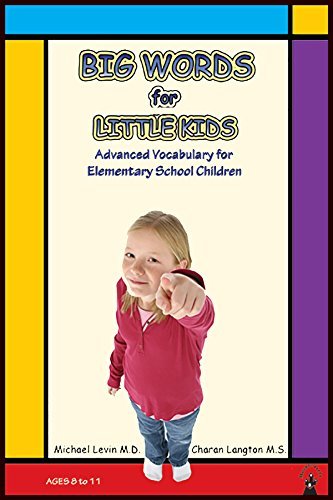
Big Words for Little Kids: Building vocabulary for children in elementary school
by Michael Levin, Charan Langton
- Tytuł oryginalny
- Atomic Habits
- Język oryginału
- Angielski
- Liczba stron
- 320
- Wydawnictwo
- Avery
O tej książce
Building a vocabulary is the most important task children face during their school years. In preschool years, children learn new words by talking to their parents, older siblings, and friends. As they learn to read, their vocabulary grows with every new book. The ability to read, however, does not always translate into understanding and reading comprehension, which are the ultimate goals of reading. The current practice in many schools is to expose children to interesting books as a way to improve their vocabulary and reading. But for many children the vocabulary stays virtually still for the first several years of elementary school, despite steady improvement in reading skills. When children encounter unfamiliar words in their reading, they either skip them altogether or try to guess the meaning by the context. Both approaches are inadequate. The new word never enters the active vocabulary, and the next time the child comes across the same word, she would either dismiss it or keep on guessing inaccurate meaning. Incidental learning becomes accidental learning. The advantages of the BigWords for Little Kids approach There are many vocabulary books that use funny stories or selection of new and interesting words in place of a systematic vocabulary approach. When developing the BigWords for Little Kids program, we took a proven vocabulary learning approach and adjusted it to the level of a younger child. Our approach is systematic and the store of words we teach though challenging, are suitable for a child at this stage of development. We use only the words that young children are likely to encounter in their everyday reading or while listening to the radio or watching television. This method of teaching vocabulary, known as the generative program, is more efficient and effective than an unsystematic approach. Children using the BigWords for Little Kids program will learn a systematic approach to learning roots and families of words. After becoming comfortable with breaking the familiar words into their parts – prefixes, suffixes, and roots – students will be able to transfer the meaning of these parts to new words. In the BigWords for Little Kids book, your child will learn a variety of methods for attacking unknown words by using his or her knowledge of familiar words. The program teaches the Greek and Latin roots, prefixes, and suffixes of words. Each new root your child learns will enable him or her to learn the meaning of other related words. The combination of generative vocabulary building technique with developmentally appropriate and gradually progressing sets of words makes the BigWords for Little Kids program an ideal teaching tool for young readers. How to teach with the BigWords for Little Kids program Each section of the book has a root, a prefix, or a suffix accompanied by four to five examples, a tidbit, exercises, and challenging words. There are sample sentences for each new word, one using the big word, the second using a familiar alternative. A short tidbit is a vignette with one of the new words. The two exercises – fill in the blank and multiple choices – do not require writing and can be done verbally. We also ask that your child make sentences using the “big words.” At the end of each section you will find challenge words.
Więcej od Michael Levin
Teach Me Writing: Learn handwriting, a companion to The Reading Lesson book
Michael Levin, Charan Langton
The Reading Lesson - Spiral version
Michael Levin, Charan Langton
The Verbal Math Lesson Level 2: Step by step math with pencil or paper
Michael Levin, Charan Langton
The Verbal Math Lesson Level 3
Michael Levin, Charan Langton