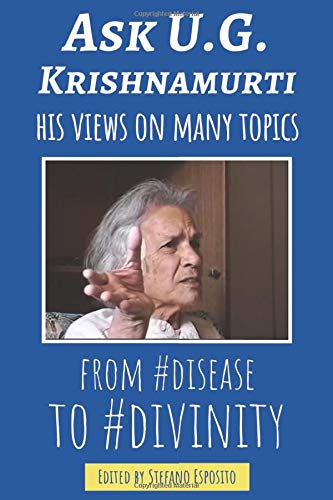
Ask U.G. Krishnamurti: His Views On Many Topics "From #Disease To #Divinity"
by U.G. Krishnamurti, Stefano Esposito
- Tytuł oryginalny
- Atomic Habits
- Język oryginału
- Angielski
- Liczba stron
- 320
- Wydawnictwo
- Avery
O tej książce
"Ask U.G. Krishnamurti" is a book of UG's "opinions" on endless topics reciprocally interconnected by hashtags. U.G. Krishnamurti cannot be framed to a philosophy or to any system or what he expresses comes from a source whose origin is completely beyond thought.Reading his books or listening to his videos is a sadhana in his words deeply shake the roots of our culture, our thinking, and ultimately our identity. Statements such "There is no self, there is no I, there is no spirit, that knocks off the whole list, and you have no way of finding out what you are left with";or"This state is not in your interest. You are only interested in continuity. You want to continue, probably on a different level, and to function in a different dimension, but you want to continue somehow. You wouldn't touch this with a barge pole. This is going to liquidate what you call "you," all of you - higher self, lower self, soul, atman, conscious, subconscious - all of that." literally pull the rug out right from under our feet. His living words put the mind in a corner and burn everything that is false letting emerge what is authentic and primeval. During all these years, while reading UG's books, I usually linked what I read to other UG's sentences spoken in other contexts; furthermore, I read more and more often - on forums or Facebook groups - about people interested in UG who ask what he had to say about this or that topic. So I thought it would be useful to collect UG's sayings and put them in this book. Here is an When, through some miracle or chance you are freed from the hold of [➝ #thought] #thought and [➝ #culture] #culture, you are left with the [➝ #body] #body's natural functions, and nothing else. It then functions without the interference of thought. Unfortunately, the servant, which is the thought structure that is there, has taken possession of the house. But he can no longer control and run the household. So he must be dislodged. It is in this sense that I use the term '[➝ #natural-state] #natural_state', without any connotation of [➝ #spirituality] #spirituality or [➝ #enlightenment] #enlightenment. In this paper version you’ll just have to jump to the contents and find the related category. There you will find other quotes with other hashtags related to other topics, and so on. You can therefore read this book in two from the beginning to the end, or by jumping from one hashtag to another. If you choose the second option you may find yourself in a maze and you can feel lost, without references, and maybe you will not be able to return to the link you clicked earlier... This feeling puzzled can be you can get the opportunity to let go of control and lose yourself in UG's words.Compiling this collection was a further I had never really realized how much each sentence of UG just stands alone, even if completely taken out of the paragraph in which it was expressed. In the same sentence can be found two or more concepts that, if isolated, remain complete in themselves. In this sense I could define UG's "teaching" as "holographic": the whole part is contained in the single part, and every single part can be traced in the whole; everything is identical to itself, complete in both the "micro-" and "macroscopic". Moreover, UG just said "Sorry, there is no teaching here, just disjointed, disconnected sentences."
Więcej od U.G. Krishnamurti
Es gibt kein "Wie": Verheerende Worte von UG Krishnamurti
U.G. Krishnamurti
The Ending of Answers: One Year with U.G. Krishnamurti One Disruptive Quote a Day
U.G. Krishnamurti, Stefano Esposito
50 Spiritual Classics: The Kingdom of God Is Within You, Daily Readings, On the Soul and the Resurrection, Lessons in Truth, The Infinite Realms of the Spirit
Leo Tolstoy, Epictetus, Henry Drummond, Frances Ridley Havergal, William Blake, Fyodor Dostoyevsky, G.K. Chesterton, George MacDonald, Florence Scovel Shinn, Charles Fillmore, Ralph Waldo Emerson, John Donne, William James, Kahlil Gibran, Miguel de Unamuno, Mahatma Gandhi, Thomas More, Helena Petrovna Blavatsky, Augustine of Hippo, Ignatius of Antioch, Edwin Arnold, Thomas à Kempis, Ignatius of Loyola, Teresa de Ávila, Jonathan Edwards, Blaise Pascal, William Walker Atkinson, Evelyn Underhill, Charles Haddon Spurgeon, Andrew Murray, John Wesley, John of the Cross, Emanuel Swedenborg, Thomas Browne, U.G. Krishnamurti, Henry Scougal, Ludwig Feuerbach, H. Emilie Cady, Gregory of Nyssa, Joseph Benner, Basil the Great, George Müller, Anne Catherine Emmerich, Reynold A. Nicholson
Awaken the Soul: 50 Transformative Works of Spiritual Insight
Leo Tolstoy, Epictetus, Henry Drummond, Frances Ridley Havergal, William Blake, Fyodor Dostoyevsky, G.K. Chesterton, George MacDonald, Florence Scovel Shinn, Charles Fillmore, Ralph Waldo Emerson, John Donne, William James, Kahlil Gibran, Miguel de Unamuno, Mahatma Gandhi, Thomas More, Helena Petrovna Blavatsky, Augustine of Hippo, Ignatius of Antioch, Edwin Arnold, Thomas à Kempis, Ignatius of Loyola, Teresa de Ávila, Jonathan Edwards, Blaise Pascal, William Walker Atkinson, Evelyn Underhill, Charles Haddon Spurgeon, Andrew Murray, John Wesley, John of the Cross, Emanuel Swedenborg, Thomas Browne, U.G. Krishnamurti, Henry Scougal, Ludwig Feuerbach, H. Emilie Cady, Gregory of Nyssa, Joseph Benner, Basil the Great, George Müller, Anne Catherine Emmerich, Reynold A. Nicholson