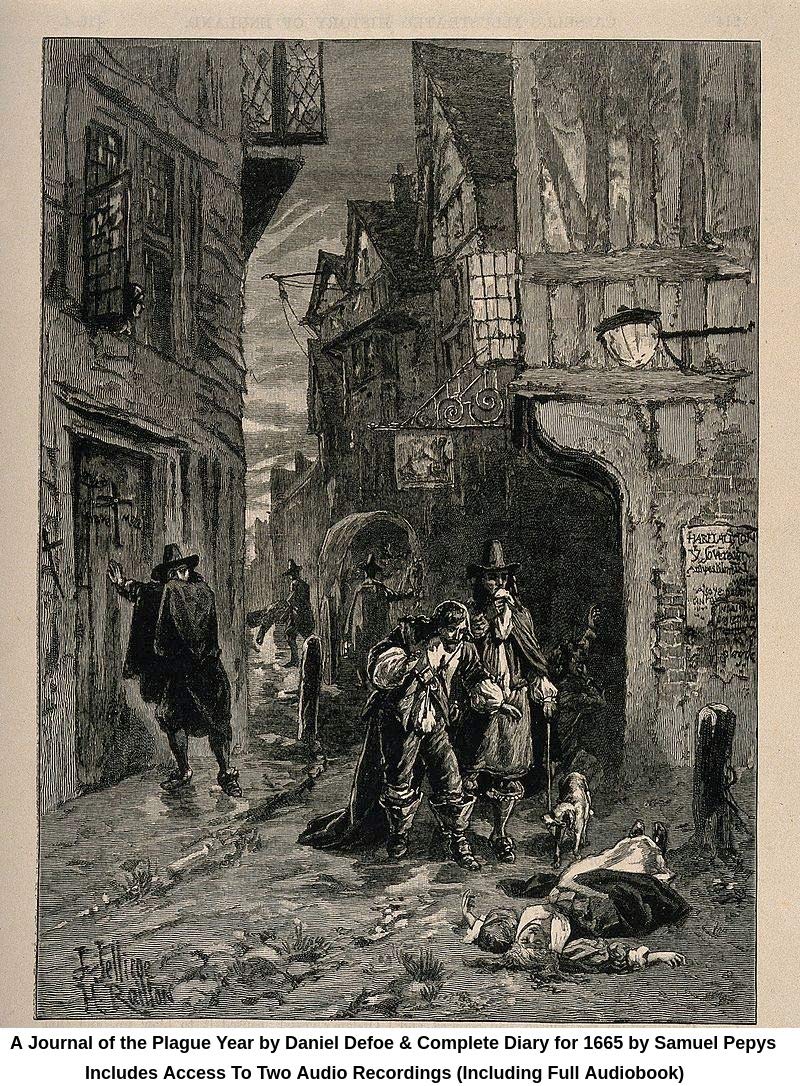
A Journal of the Plague Year / Samuel Pepys' Diary for 1665
- Tytuł oryginalny
- Atomic Habits
- Język oryginału
- Angielski
- Liczba stron
- 320
- Wydawnictwo
- Avery
O tej książce
The Great Plague of London of 1665 was the last serious epidemic of bubonic plage to happen in England. It occurred during the centuries-long period of the Second Pandemic, a historical era of sporadic bubonic plague epidemics. These plagues originated from Central Asia in 1331, the first year of the Black Death, an outbreak which coincided with other forms such as pneumonic plague. This period of intermittent bubonic plague outbreaks lasted until 1750.Within a period of 18 months, the Great Plague claimed the lives of approximately 100,000 people, virtually a quarter of London's population at the time. The plague was the result of being bitten by fleas, carried by rats, infected by the Yersina pestis bacterium.The Great Plague is especially relevant today as the panic and reactions it caused in its time are reflected in ours during the Covid pandemic.These are the two key texts relating to this period of English history. They come here together in one ebook accompanied by two audio recordings (including a full audiobook of Defoe's work).Daniel Defoe's' A Journal of the Plague YearA Journal of the Plague Year is a book by Daniel Defoe, first published in March 1722. It is an account of one man's experiences of the year 1665, in which the bubonic plague struck the city of London in what became known as the Great Plague of London, the last epidemic of plague in that city. The book is told somewhat chronologically, though without sections or chapter headings (they have been added in this version for ease of reading), and with frequent digressions and repetitions.Samuel Pepys' Plague Year Diary (Complete Year) 1665He recorded his daily life for almost ten years. This record of a decade of Pepys's life is more than a million words long and is often regarded as Britain's most celebrated diary. Pepys has been called the greatest diarist of all time due to his frankness in writing concerning his own weaknesses and the accuracy with which he records events of daily British life and major events in the 17th century. Pepys wrote about the contemporary court and theatre, his household, and major political and social occurrences.Historians have been using his diary to gain greater insight and understanding of life in London in the 17th century. Pepys wrote consistently on subjects such as personal finances, the time he got up in the morning, the weather, and what he ate. He wrote at length about his new watch which he was very proud of (and which had an alarm, a new accessory at the time), a country visitor who did not enjoy his time in London because he felt that it was too crowded, and his cat waking him up at one in the morning. Pepys's diary is one of a very few sources which provides such length in details of everyday life of an upper-middle-class man during the seventeenth century.Aside from day-to-day activities, Pepys also commented on the significant and turbulent events of his nation. England was in disarray when he began writing his diary. Oliver Cromwell had died just a few years before, creating a period of civil unrest and a large power vacuum to be filled. Pepys had been a strong supporter of Cromwell, but he converted to the Royalist cause upon the Protector's death. He was on the ship that returned Charles II to England to take up his throne, and gave first-hand accounts of other significant events from the early years of the Restoration, such as the coronation of Charles II, the Great Plague, the Great Fire of London and the Anglo–Dutch Wars.Pepys did not plan on his contemporaries ever seeing his diary, which is evident from the fact that he wrote in shorthand and sometimes in a "code" of various Spanish, French, and Italian words.This is the plague year of his diary, 1665.Individual book descriptions from Wikipedia.
Więcej od Daniel Defoe
Spring: A Folio Anthology
William Shakespeare, George Orwell, Samuel Taylor Coleridge, Anton Chekhov, Toni Morrison, Oscar Wilde, William Wordsworth, Kenneth Grahame, Beatrix Potter, Virginia Woolf, P.G. Wodehouse, Victor Hugo, Richard Mabey, Robert Graves, Henry David Thoreau, Petra Börner, Dorothy Wordsworth, Francis Kilvert, Edward Thomas, Virgil, Sue Bradbury, Elizabeth David, Dorothy Parker, Herbert Read, Rachel Carson, Thomas Malory, Robert Browning, Dylan Thomas, John Keats, Edna St. Vincent Millay, Geoffrey Chaucer, Vita Sackville-West, John Clare, Penelope Fitzgerald, Jules de Goncourt, Edmond de Goncourt, Philip Larkin, Alexander Pushkin, John Lewis-Stempel, Robert Falcon Scott, Thomas Dekker, Owen Wister, Heng-fu Chao, Federico García Lorca, Samuel Pepys, Alan Seeger, Vernon Duke, E.Y. Harburg, Amy Lowell, Ōtomo no Yakamochi, Walter Williamson, Gustav Eckstein, Horatius, James Woodforde, Paul Evans, Charles of Orleans, Gerald Manley Hopkins, Hugh MacDiarmid, John Webster, Maurice Baring, Gerald Durrell, William Russell, Angus Buchanun, A.E. Housman, Frank. A. Worsley, Joyce Grenfell, Gavin Maxwell
20 cuentos infantiles clásicos de siempre
Jonathan Swift, Lewis Carroll, Hans Christian Andersen, Jacob Grimm, Wilhelm Grimm, Daniel Defoe, Carlo Collodi, Jean de la Fontaine, Charles Perrault, Félix María de Samaniego
25 Favorite Kid's Books for Middle Young Adult Readers
Jonathan Swift, Robert Louis Stevenson, Charles Dickens, Jack London, Louisa May Alcott, Mark Twain, Kenneth Grahame, Washington Irving, L. Frank Baum, Rudyard Kipling, Jules Verne, L.M. Montgomery, Johann David Wyss, Daniel Defoe, Frances Hodgson Burnett, Johanna Spyri, Anna Sewell, Eleanor H. Porter
40+ Beliebtesten Abenteuerromane in einem Band (Illustriert): Die Reise zum Mittelpunkt der Erde, Moby Dick, Der Graf von Monte Christo, Die Schatzinsel, ... Das Herz der Finsternis...
Jonathan Swift, Robert Louis Stevenson, Charles Dickens, Edgar Allan Poe, Mark Twain, Walter Scott, Arthur Conan Doyle, Rudyard Kipling, G.K. Chesterton, Joseph Conrad, Jules Verne, Herman Melville, Alexandre Dumas, E.W. Kemble, Daniel Defoe, True Williams, Friedrich Gerstäcker, James Fenimore Cooper, Pierre Loti, Heinrich Zschokke, Karl May, Amalie Schoppe, Gustave Aimard, Frederick Marryat, Walter Zweigle, David Scattergood, Sophie Wörishöffer, Franz Treller, Miguel de Cervantes Saavedra, Emilio Salgari, Robert Kraft, Carl Offterdinger