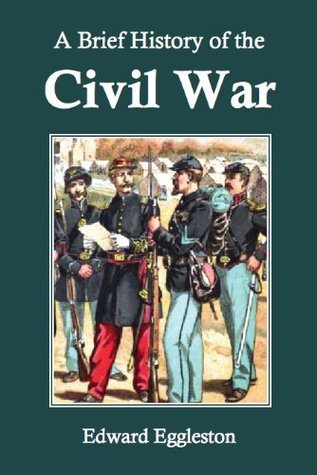
A Brief History of the Civil War
- Tytuł oryginalny
- Atomic Habits
- Język oryginału
- Angielski
- Liczba stron
- 320
- Wydawnictwo
- Avery
O tej książce
Originally published in 1891 as a portion of the author’s larger “The Household History of the United States and Its People,” this Kindle edition, equivalent in length to a physical book of approximately 40 pages, recounts, in simple language, the history of America’s Civil War.CONTENTSI. How the Great Civil War BeganII. Confederate Victory at Bull Run—The First Western CampaignIII. The War in the East—From Bull Run to GettysburgIV. Various Operations in 1862 and 1863V. The Campaign Between Nashville and AtlantaVI. From the Wilderness to Petersburg—The War in the ValleyVII. Close of the Civil WarVIII. Traits and Results of the War—Death of LincolnSample are to remember that, though the war was caused by slavery, it was not at first about slavery, but about secession. “Our States are sovereign, and have a right to secede when they think they have reason,” was the Southern view of the matter. “You are a part of the Union, which forms but one nation, and to break up the Union is rebellion,” was the Northern view. But the passions excited by the long and bitter debate over questions relating to slavery lay at the bottom of the struggle. Neither side dreamed of the weary and bloody conflict which was to follow. Each expected to settle the matter in two or three battles. Both of them found out what stubborn work it was to fight against Americans.The Southerners were naturally more military than the Northern people; they were generally accustomed to the saddle and the use of firearms. Many of the Northern men, especially those of the Eastern States, had to learn to load and fire a gun after they went into the army. For a long war the North had several advantages. Money, trade, and the mechanical facilities for producing arms, ships, clothing, and other military necessities, belonged in a superior degree to the North. It had also the advantage of numbers; the South the advantage of fighting in defense of its own ground, and of moving on shorter lines.About the Eggleston (1837-1902) discovered a gift for writing when he was a high school student in Indiana. His militant opposition to slavery, however, caused him to refuse an offer to attend the University of Virginia. In 1871 he began a career as a popular novelist, but eventually his interest shifted from fiction to history. Other works include “The Beginning of a Nation” and “A First Book in American History.”
Więcej od Edward Eggleston
(Handbill): Edward Eggleston 1837-1902
Edward Eggleston
39 Great Classics for Young Readers
Jonathan Swift, Robert Louis Stevenson, Charles Dickens, Lewis Carroll, Edgar Rice Burroughs, Jack London, Hans Christian Andersen, Louisa May Alcott, Mark Twain, Kenneth Grahame, L. Frank Baum, Rudyard Kipling, Jules Verne, Herman Melville, H. Rider Haggard, J.M. Barrie, Alice Caldwell Hegan Rice, Johanna Spyri, Eleanor H. Porter, Charles Kingsley, Susan Coolidge, Edward Eggleston, Jean Webster, Jane L. Stewart, Dorothy Kilner, Ethel C. Pedley, France Hodgson Burnett, George Fyler Townsend
A First Book in American History: With Special Reference to the Lives and Deeds of Great Americans
Edward Eggleston
A History of Life in The United States
Edward Eggleston