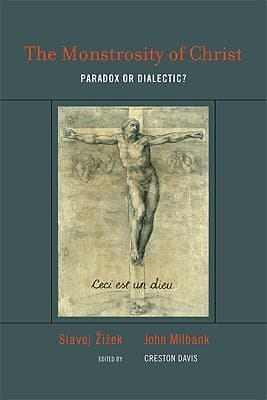
The Monstrosity of Christ: Paradox or Dialectic?
autor Slavoj Žižek, John Milbank
O tej książce
A militant Marxist atheist and a “Radical Orthodox” Christian theologian square off on everything from the meaning of theology and Christ to the war machine of corporate mafia.In this corner, philosopher Slavoj Žižek, a militant atheist who represents the critical-materialist stance against religion's illusions; in the other corner, “Radical Orthodox” theologian John Milbank, an influential and provocative thinker who argues that theology is the only foundation upon which knowledge, politics, and ethics can stand. In The Monstrosity of Christ, Žižek and Milbank go head to head for three rounds, employing an impressive arsenal of moves to advance their positions and press their respective advantages. By the closing bell, they have not only proven themselves worthy adversaries, they have shown that faith and reason are not simply and intractably opposed. Žižek has long been interested in the emancipatory potential offered by Christian theology. And Milbank, seeing global capitalism as the new century's greatest ethical challenge, has pushed his own ontology in more political and materialist directions.Their debate in The Monstrosity of Christ concerns the future of religion, secularity, and political hope in light of a monsterful event—God becoming human. For the first time since Žižek's turn toward theology, we have a true debate between an atheist and a theologian about the very meaning of theology, Christ, the Church, the Holy Ghost, Universality, and the foundations of logic. The result goes far beyond the popularized atheist/theist point/counterpoint of recent books by Christopher Hitchens, Richard Dawkins, and others. Žižek begins, and Milbank answers, countering dialectics with “paradox.” The debate centers on the nature of and relation between paradox and parallax, between analogy and dialectics, between transcendent glory and liberation.
Gdzie kupić
Brak dostępnych opcji zakupu.
Linki w tej sekcji są linkami afiliacyjnymi - jeśli po kliknięciu kupisz książkę, otrzymamy prowizję od sklepu. Cena dla Ciebie pozostaje taka sama.
Więcej od Slavoj Žižek

Theology and Social Theory: Beyond Secular Reason
John Milbank

Contingency, Hegemony, Universality: Contemporary Dialogues on the Left
Slavoj Žižek, Judith Butler, Ernesto Laclau
Democracy in What State?
Slavoj Žižek, Jean-Luc Nancy, Giorgio Agamben, Alain Badiou, Kristin Ross, Wendy Brown, Jacques Rancière, Daniel Bensaïd
Did Somebody Say Totalitarianism?: Five Interventions in the (Mis)use of a Notion
Slavoj Žižek
Everything You Always Wanted to Know about Lacan
Fredric Jameson, Slavoj Žižek, Michel Chion, Renata Salecl, Mladen Dolar, Alenka Zupančič, Miran Božovič, Stojan Pelko, Pascal Bonitzer
For They Know Not What They Do: Enjoyment as a Political Factor
Slavoj Žižek
How to Read Lacan
Slavoj Žižek
Interrogating the Real
Slavoj Žižek

Iraq: The Borrowed Kettle
Slavoj Žižek
Looking Awry: An Introduction to Jacques Lacan through Popular Culture
Slavoj Žižek
Mapping Ideology
Slavoj Žižek

The Art of the Ridiculous Sublime: On David Lynch's Lost Highway
Slavoj Žižek
Metastazy rozkoszy. Sześć esejów o kobietach i przyczynowości
Slavoj Žižek
The Neighbor: Three Inquiries in Political Theology
Slavoj Žižek, Eric L. Santner, Kenneth Reinhard
The Parallax View
Slavoj Žižek
The Puppet and the Dwarf: The Perverse Core of Christianity
Slavoj Žižek
Wzniosły obiekt ideologii
Slavoj Žižek
The Ticklish Subject: The Absent Centre of Political Ontology
Slavoj Žižek

Przemoc. Sześć spojrzeń z ukosa
Slavoj Žižek
Welcome to the Desert of the Real: Five Essays on September 11 and Related Dates
Slavoj Žižek