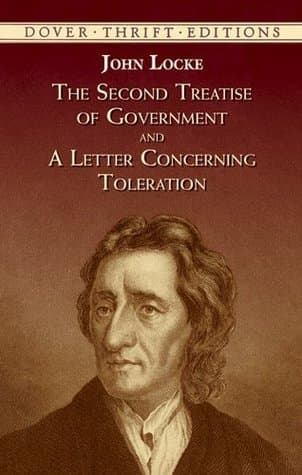
O tej książce
The first of these two highly influential documents refutes the concept of monarchy's divine right. The second argues for a broad acceptance of alternative religious convictions. The basis of social and political philosophy for generations, these books laid the foundation of the modern democratic state in England and abroad.
Gdzie kupić
Brak dostępnych opcji zakupu.
Linki w tej sekcji są linkami afiliacyjnymi - jeśli po kliknięciu kupisz książkę, otrzymamy prowizję od sklepu. Cena dla Ciebie pozostaje taka sama.
Więcej od John Locke
A Letter Concerning Toleration
John Locke, James H. Tully
Rozważania dotyczące rozumu ludzkiego
John Locke
John Locke: 7 Works
John Locke
Locke: Political Writings
John Locke, Gerald Green
Of the Abuse of Words
John Locke
Second Treatise of Government
John Locke
Social Contract: Essays by Locke, Hume, and Rousseau
David Hume, Jean-Jacques Rousseau, John Locke, Ernest Barker
Some Thoughts Concerning Education
John Locke

The Complete Harvard Classics - ALL 71 Volumes: The Five Foot Shelf & The Shelf of Fiction: The Famous Anthology of the Greatest Works of World Literature
Honoré de Balzac, George Sand, Mark Twain, Jane Austen, Nathaniel Hawthorne, John Dryden, Percy Bysshe Shelley, Euripides, Theodor Storm, Thomas Hobbes, Sophocles, Blaise Pascal, Ben Jonson, Laurence Sterne, Thomas Carlyle, Francis Bacon, William Makepeace Thackeray, John Milton, James Russell Lowell, Henry James, Plato, John Fletcher, Edward Everett Hale, Bret Harte, Guy de Maupassant, Washington Irving, René Descartes, John Webster, Theodor Fontane, Jonathan Swift, Sydney Smith, Thomas de Quincey, Alessandro Manzoni, Alfred de Musset, Gotthold Ephraim Lessing, William Shakespeare, Walter Scott, Charles Darwin, Marcus Aurelius, Juan Valera, Christopher Marlowe, Benvenuto Cellini, Adam Smith, Martin Luther, Philip Sidney, Henry Fielding, Thomas Dekker, Thomas Malory, Marcus Tullius Cicero, Epictetus, John Bunyan, Oliver Goldsmith, Francis Beaumont, Gottfried Keller, Philip Massinger, Abraham Cowley, Joseph Lister, Walter Raleigh, William Harvey, Jean Froissart, Thomas à Kempis, William Penn, Ambroise Paré, William Allan Neilson, Louis Pasteur, Francis Drake, Tacitus, Miguel de Cervantes Saavedra, Fyodor Dostoevsky, Charles William Eliot, Ernest Renan, Aeschylus, Hans Christian Andersen, Aesop, Charles Lamb, Ivan Turgenev, John Woolman, Simon Newcomb, Augustine of Hippo, John Ruskin, Immanuel Kant, Lord Byron, John Locke, Homer, Richard Steele, David Garrick, Walter Bigges, Samuel Johnson, Thomas Babington Macaulay, Edward Haies, Voltaire, Michel de Montaigne, Thomas Browne, Robert Burns, George Eliot, Aristophanes, Daniel Defoe, Edmund Burke, Alphonse Daudet, Leigh Hunt, Charles-Augustin Sainte-Beuve, Michael Faraday, Hermann von Helmholtz, Pliny the Younger, Friedrich Schiller, Wilhelm Grimm, Herodotus, Jean-Jacques Rousseau, Samuel Taylor Coleridge, Giuseppe Mazzini, Victor Hugo, Richard Brinsley Sheridan, Richard Henry Dana Jr., William Henry Harrison, Dante Alighieri, Izaak Walton, Johann Wolfgang von Goethe, John Stuart Mill, George Berkeley, Leo Tolstoy, Bjørnstjerne Bjørnson, Alexander L. Kielland, Edgar Allan Poe, Benjamin Franklin, Philip Nichols, Archibald Geikie, Thomas More, Robert Louis Stevenson, Oliver Wendell Holmes Sr., Pierre Corneille, Francis Pretty, Jacob Grimm, Virgil, Ralph Waldo Emerson, Niccolò Machiavelli, Plutarch, Pedro Calderón de la Barca, Charles Dickens, Henry David Thoreau, Molière, Hippocrates, Jean Racine, Robert Browning, Joseph Addison, William Roper
The Reasonableness of Christianity with a Discourse of Miracles & Part of a Third Letter Concerning Toleration
John Locke

Dwa traktaty o rządzie
John Locke
Works of John Locke
John Locke