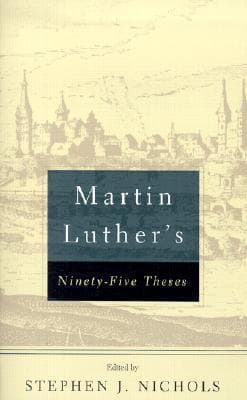
O tej książce
2018 Reprint of 1910 Harvard Classics Edition. The Ninety-five Theses or Disputation on the Power of Indulgences by Martin Luther is a list of propositions for an academic disputation written in 1517. It is considered a foundation document for Protestantism and the beginning of the Reformation in Europe. Luther was professor of moral theology at the University of Wittenberg, Germany, and with the publication of this document he precipitated a schism in the Catholic Church which profoundly changed Europe. The Theses advanced Luther's positions against what he saw as the abuse of the practice of clergy selling plenary indulgences, which were certificates believed to reduce the temporal punishment in purgatory for sins committed by the purchasers or their loved ones. In the Theses, Luther claimed that the repentance required by Christ for sins to be forgiven involves inner spiritual repentance rather than merely external sacramental confession. He argued that indulgences led Christians to avoid true repentance and sorrow for sin, believing that they could forgo it by purchasing an indulgence. Indulgences also, according to Luther, discouraged Christians from giving to the poor and performing other acts of mercy, believing that indulgence certificates were more spiritually valuable. Though Luther claimed that his positions on indulgences accorded with those of the Pope, the Theses challenge a 14th-century papal bull stating that the pope could use the treasury of merit and the good deeds of past saints to forgive temporal punishment for sins.
Gdzie kupić
Brak dostępnych opcji zakupu.
Linki w tej sekcji są linkami afiliacyjnymi - jeśli po kliknięciu kupisz książkę, otrzymamy prowizję od sklepu. Cena dla Ciebie pozostaje taka sama.
Więcej od Martin Luther
A Simple Way to Pray
Martin Luther
A Treatise on Good Works
Martin Luther
Basic Theological Writings
Martin Luther, Jaroslav Pelikan
Commentary on Galatians
Martin Luther
Commentary on Romans
Martin Luther
Faith Alone: A Daily Devotional
Martin Luther, James C. Galvin
Large Catechism of Martin Luther
Martin Luther
Luther and Calvin on Secular Authority
Martin Luther, John Calvin
Martin Luther's Christmas Book
Roland H. Bainton, Martin Luther
Martin Luther: Selections from His Writings
John Dillenberger, Martin Luther
On Christian Liberty
Martin Luther

On The Babylonian Captivity of the Church
Martin Luther
Reading the Psalms with Luther
Martin Luther
Selections from the Table Talk of Martin Luther
Martin Luther
Small Catechism, with Explanation
Martin Luther
The Bondage of the Will
Martin Luther
The Book of Concord (New Translation): The Confessions of the Evangelical Lutheran Church
Philipp Melanchthon, Martin Luther
The Complete Harvard Classics - ALL 71 Volumes: The Five Foot Shelf & The Shelf of Fiction: The Famous Anthology of the Greatest Works of World Literature
Honoré de Balzac, George Sand, Mark Twain, Jane Austen, Nathaniel Hawthorne, John Dryden, Percy Bysshe Shelley, Euripides, Theodor Storm, Thomas Hobbes, Sophocles, Blaise Pascal, Ben Jonson, Laurence Sterne, Thomas Carlyle, Francis Bacon, William Makepeace Thackeray, John Milton, James Russell Lowell, Henry James, Plato, John Fletcher, Edward Everett Hale, Bret Harte, Guy de Maupassant, Washington Irving, René Descartes, John Webster, Theodor Fontane, Jonathan Swift, Sydney Smith, Thomas de Quincey, Alessandro Manzoni, Alfred de Musset, Gotthold Ephraim Lessing, William Shakespeare, Walter Scott, Charles Darwin, Marcus Aurelius, Juan Valera, Christopher Marlowe, Benvenuto Cellini, Adam Smith, Martin Luther, Philip Sidney, Henry Fielding, Thomas Dekker, Thomas Malory, Marcus Tullius Cicero, Epictetus, John Bunyan, Oliver Goldsmith, Francis Beaumont, Gottfried Keller, Philip Massinger, Abraham Cowley, Joseph Lister, Walter Raleigh, William Harvey, Jean Froissart, Thomas à Kempis, William Penn, Ambroise Paré, William Allan Neilson, Louis Pasteur, Francis Drake, Tacitus, Miguel de Cervantes Saavedra, Fyodor Dostoevsky, Charles William Eliot, Ernest Renan, Aeschylus, Hans Christian Andersen, Aesop, Charles Lamb, Ivan Turgenev, John Woolman, Simon Newcomb, Augustine of Hippo, John Ruskin, Immanuel Kant, Lord Byron, John Locke, Homer, Richard Steele, David Garrick, Walter Bigges, Samuel Johnson, Thomas Babington Macaulay, Edward Haies, Voltaire, Michel de Montaigne, Thomas Browne, Robert Burns, George Eliot, Aristophanes, Daniel Defoe, Edmund Burke, Alphonse Daudet, Leigh Hunt, Charles-Augustin Sainte-Beuve, Michael Faraday, Hermann von Helmholtz, Pliny the Younger, Friedrich Schiller, Wilhelm Grimm, Herodotus, Jean-Jacques Rousseau, Samuel Taylor Coleridge, Giuseppe Mazzini, Victor Hugo, Richard Brinsley Sheridan, Richard Henry Dana Jr., William Henry Harrison, Dante Alighieri, Izaak Walton, Johann Wolfgang von Goethe, John Stuart Mill, George Berkeley, Leo Tolstoy, Bjørnstjerne Bjørnson, Alexander L. Kielland, Edgar Allan Poe, Benjamin Franklin, Philip Nichols, Archibald Geikie, Thomas More, Robert Louis Stevenson, Oliver Wendell Holmes Sr., Pierre Corneille, Francis Pretty, Jacob Grimm, Virgil, Ralph Waldo Emerson, Niccolò Machiavelli, Plutarch, Pedro Calderón de la Barca, Charles Dickens, Henry David Thoreau, Molière, Hippocrates, Jean Racine, Robert Browning, Joseph Addison, William Roper

The Debate on the Constitution, Part 1: Federalist and Anti-Federalist Speeches, Articles, and Letters During the Struggle over Ratification: September 1787 to February 1788
Samuel Osgood, Robert Whitehill, William Jones, George Mason, Fisher Ames, Samuel Nasson, Richard Henry Lee, Christopher Gore, Timothy Pickering, Elbridge Gerry, Daniel Shute, Nathaniel Barrell, Samuel Huntington, William Heath, Samuel West, William Findley, Charles Turner, Thomas Dawes Jr., Isaac Snow, James Madison, Pelatiah Webster, Benjamin Workman, Benjamin Franklin, Roger Sherman, James Winthrop, John Hancock, Louis-Guillaume Otto, John Stevens Jr., Joseph Barrell, Lawrence Taliaferro, Jonathan Smith, Edmund Randolph, Samuel Adams, Arthur Lee, Noah Webster, Benjamin Rush, Thomas Jefferson, Charles Jarvis, Isaac Backus, Francis Hopkinson, John Adams, David Redick, Ezra Stiles, Oliver Ellsworth, Thomas Baker Wait, John Smilie, George Bryan, Eleonore François Elie, Samuel Holden Parsons, William Widgery, Samuel Thomspon, Joseph Bradley Varnum, James Wilson, James Iredell, Abraham Holmes, Alexander Hamilton, Increase Sumner, Martin Luther, Martin Kinsley, Amos Singletary, George Washington, George Lee Turberville, Tench Coxe, Samuel Bryan, James Wadsworth