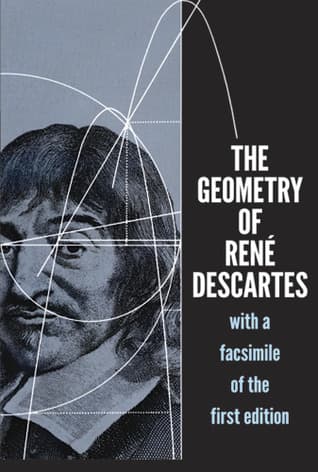
The Geometry of René Descartes: with a Facsimile of the First Edition
autor René Descartes
O tej książce
This is an unabridged republication of the definitive English translation of one of the very greatest classics of science. Originally published in 1637, it has been characterized as "the greatest single step ever made in the progress of the exact sciences" (John Stuart Mill); as a book which "remade geometry and made modern geometry possible" (Eric Temple Bell). It "revolutionized the entire conception of the object of mathematical science" (J. Hadamard).With this volume Descartes founded modern analytical geometry. Reducing geometry to algebra and analysis and, conversely, showing that analysis may be translated into geometry, it opened the way for modern mathematics. Descartes was the first to classify curves systematically and to demonstrate algebraic solution of geometric curves. His geometric interpretation of negative quantities led to later concepts of continuity and the theory of function. The third book contains important contributions to the theory of equations.This edition contains the entire definitive Smith-Latham translation of Descartes' three Problems the Construction of which Requires Only Straight Lines and Circles ; On the Nature of Curved Lines ; and On the Construction of Solid and Supersolid Problems . Interleaved page by page with the translation is a complete facsimile of the 1637 French text, together with all Descartes' original illustrations; 248 footnotes explain the text and add further bibliography.
Gdzie kupić
Brak dostępnych opcji zakupu.
Linki w tej sekcji są linkami afiliacyjnymi - jeśli po kliknięciu kupisz książkę, otrzymamy prowizję od sklepu. Cena dla Ciebie pozostaje taka sama.
Więcej od René Descartes

Rozprawa o metodzie
René Descartes, محمود محمد الخضيري

Discourse on Method and Meditations on First Philosophy
René Descartes

Discourse on Method and Related Writings
René Descartes

Key Philosophical Writings
René Descartes

Medytacje o pierwszej filozofii
René Descartes

Meditations on First Philosophy, with Selections from the Objections and Replies
René Descartes
O Discurso do Método / As Paixões da Alma
René Descartes

Rules for the Direction of the Mind
René Descartes
Selected Philosophical Writings
René Descartes

The Complete Harvard Classics - ALL 71 Volumes: The Five Foot Shelf & The Shelf of Fiction: The Famous Anthology of the Greatest Works of World Literature
Marcus Aurelius, William Shakespeare, Benjamin Franklin, Adam Smith, Leo Tolstoy, Fyodor Dostoevsky, Jonathan Swift, Charles Darwin, Niccolò Machiavelli, Epictetus, Charles Dickens, Jean-Jacques Rousseau, Martin Luther, Robert Burns, Guy de Maupassant, Robert Louis Stevenson, Edgar Allan Poe, Hans Christian Andersen, Lord Byron, Plato, Immanuel Kant, René Descartes, John Stuart Mill, Aristophanes, Bret Harte, Ivan Turgenev, Henry David Thoreau, John Locke, Blaise Pascal, Izaak Walton, Henry James, Nathaniel Hawthorne, Washington Irving, Samuel Taylor Coleridge, Percy Bysshe Shelley, Michel de Montaigne, Henry Fielding, Walter Scott, John Milton, Jane Austen, Plutarch, Mark Twain, Ralph Waldo Emerson, Jean Racine, Jacob Grimm, Wilhelm Grimm, Homer, George Sand, Philip Sidney, Miguel de Cervantes Saavedra, Dante Alighieri, John Dryden, Francis Bacon, Thomas Browne, Charles William Eliot, Thomas More, Honoré de Balzac, Daniel Defoe, Aesop, Gottfried Keller, Theodor Storm, Johann Wolfgang von Goethe, Voltaire, Sophocles, Euripides, Aeschylus, Molière, Marcus Tullius Cicero, Ben Jonson, Robert Browning, Thomas Dekker, John Webster, Augustine of Hippo, Victor Hugo, Oliver Goldsmith, Pierre Corneille, William Allan Neilson, William Makepeace Thackeray, Edward Everett Hale, Oliver Wendell Holmes Sr., Charles Lamb, Christopher Marlowe, Thomas Carlyle, Virgil, John Fletcher, Abraham Cowley, George Eliot, Gotthold Ephraim Lessing, Alfred de Musset, Alphonse Daudet, William Penn, John Woolman, Thomas de Quincey, John Bunyan, Joseph Addison, Richard Steele, David Garrick, Herodotus, John Ruskin, Sydney Smith, Thomas Hobbes, Benvenuto Cellini, James Russell Lowell, Edmund Burke, Samuel Johnson, Laurence Sterne, Juan Valera, Giuseppe Mazzini, Thomas Malory, Francis Beaumont, Theodor Fontane, Richard Brinsley Sheridan, George Berkeley, Michael Faraday, Thomas à Kempis, Alessandro Manzoni, William Harvey, Hermann von Helmholtz, Philip Massinger, William Roper, Richard Henry Dana Jr., Leigh Hunt, Pedro Calderón de la Barca, Jean Froissart, Thomas Babington Macaulay, Hippocrates, William Henry Harrison, Pliny the Younger, Philip Nichols, Archibald Geikie, Charles-Augustin Sainte-Beuve, Ambroise Paré, Bjørnstjerne Bjørnson, Joseph Lister, Louis Pasteur, Francis Drake, Simon Newcomb, Walter Raleigh, Friedrich Schiller, Tacitus, Francis Pretty, Edward Haies, Walter Bigges, Alexander L. Kielland, Ernest Renan

The Passions of the Soul
René Descartes
The Philosophical Writings of Descartes, Volume I
René Descartes

The Philosophical Writings of Descartes, Volume II
René Descartes

The Selections from the Principles of Philosophy
René Descartes

The Works of Rene Descartes
René Descartes

ten-great-works-of-philosophy
Various, Plato, Aristotle, Immanuel Kant, William James, Robert Paul Wolff, René Descartes, David Hume, John Stuart Mill, Thomas Aquinas, Anselm of Canterbury
محاورة ديكارت : البحث عن الحقيقة بواسطة النور الطبيعي
René Descartes, ديكارت