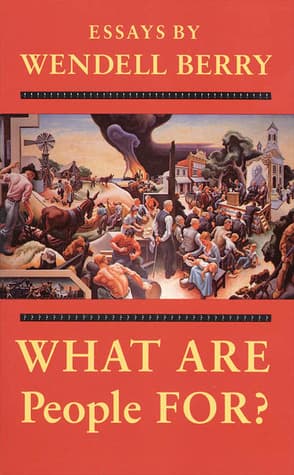
What Are People For?
autor Wendell Berry
O tej książce
In the twenty-two essays collected here, Wendell Berry, whom "The Christian Science Monitor "called ""the "prophetic American voice of our day," conveys a deep concern for the American economic system and the gluttonous American consumer. Berry talks to the reader as one would talk to a next-door neighbor: never preachy, he comes across as someone offering sound advice. He speaks with sadness of the greedy consumption of this country's natural resources and the grim consequences Americans must face if current economic practices do not change drastically. In the end, these essays offer rays of hope in an otherwise bleak forecast of America's future. Berry's program presents convincing steps for America's agricultural and cultural survival.Damage --Healing --A remarkable man [Nate Shaw] --Harry Caudill in the Cumberlands --A few words in favor of Edward Abbey --Wallace Stegner and the great community --A poem of difficult hope --Style and grace --Writer and region --The responsibility of the poet --God and country --A practical harmony --An argument for diversity --What are people for? --Waste --Economy and pleasure --The pleasures of eating --The work of local culture --Why I am not going to buy a computer --Feminism, the body, and the machine --Word and flesh --Nature as measure
Gdzie kupić
Brak dostępnych opcji zakupu.
Linki w tej sekcji są linkami afiliacyjnymi - jeśli po kliknięciu kupisz książkę, otrzymamy prowizję od sklepu. Cena dla Ciebie pozostaje taka sama.
Więcej od Wendell Berry
A Place on Earth
Wendell Berry

A Timbered Choir: The Sabbath Poems 1979-1997
Wendell Berry

Blessed are the Peacemakers: Christ's Teachings of Love, Compassion, and Forgiveness
Wendell Berry
Bread and Wine: Readings for Lent and Easter
Clarence Jordan, Henri J.M. Nouwen, Oscar Wilde, Madeleine L'Engle, Wendell Berry, John Donne, Thomas Merton, Dorothy L. Sayers, Dorothy Day, Toyohiko Kagawa, Soren Kierkegaard, Eberhard Arnold, Christina Rosetti, Kathleen Norris, Khalil Gibran, C.S. Lewis, Fleming Rutledge, Simone Weil, Dietrich Bonhoeffer, Edith Stein