An Inquiry into the Nature and Causes of the Wealth of Nations, Volume II
autor Adam Smith
O tej książce
First published in 1776, the year in which the American Revolution officially began, Smith’s Wealth of Nations sparked a revolution of its own. In it Smith analyzes the major elements of political economy, from market pricing and the division of labor to monetary, tax, trade, and other government policies that affect economic behavior. Throughout he offers seminal arguments for free trade, free markets, and limited government.Criticizing mercantilists who sought to use the state to increase their nations’ supply of precious metals, Smith points out that a nation’s wealth should be measured by the well-being of its people. Prosperity in turn requires voluntary exchange of goods in a peaceful, well-ordered market. How to establish and maintain such markets? For Smith the answer lay in man’s social instincts, which government may encourage by upholding social standards of decency, honesty, and virtue, but which government undermines when it unduly interferes with the intrinsically private functions of production and exchange.
Gdzie kupić
Brak dostępnych opcji zakupu.
Linki w tej sekcji są linkami afiliacyjnymi - jeśli po kliknięciu kupisz książkę, otrzymamy prowizję od sklepu. Cena dla Ciebie pozostaje taka sama.
Więcej od Adam Smith
Bogactwo narodów
Adam Smith

The Complete Harvard Classics - ALL 71 Volumes: The Five Foot Shelf & The Shelf of Fiction: The Famous Anthology of the Greatest Works of World Literature
Honoré de Balzac, George Sand, Mark Twain, Jane Austen, Nathaniel Hawthorne, John Dryden, Percy Bysshe Shelley, Euripides, Theodor Storm, Thomas Hobbes, Sophocles, Blaise Pascal, Ben Jonson, Laurence Sterne, Thomas Carlyle, Francis Bacon, William Makepeace Thackeray, John Milton, James Russell Lowell, Henry James, Plato, John Fletcher, Edward Everett Hale, Bret Harte, Guy de Maupassant, Washington Irving, René Descartes, John Webster, Theodor Fontane, Jonathan Swift, Sydney Smith, Thomas de Quincey, Alessandro Manzoni, Alfred de Musset, Gotthold Ephraim Lessing, William Shakespeare, Walter Scott, Charles Darwin, Marcus Aurelius, Juan Valera, Christopher Marlowe, Benvenuto Cellini, Adam Smith, Martin Luther, Philip Sidney, Henry Fielding, Thomas Dekker, Thomas Malory, Marcus Tullius Cicero, Epictetus, John Bunyan, Oliver Goldsmith, Francis Beaumont, Gottfried Keller, Philip Massinger, Abraham Cowley, Joseph Lister, Walter Raleigh, William Harvey, Jean Froissart, Thomas à Kempis, William Penn, Ambroise Paré, William Allan Neilson, Louis Pasteur, Francis Drake, Tacitus, Miguel de Cervantes Saavedra, Fyodor Dostoevsky, Charles William Eliot, Ernest Renan, Aeschylus, Hans Christian Andersen, Aesop, Charles Lamb, Ivan Turgenev, John Woolman, Simon Newcomb, Augustine of Hippo, John Ruskin, Immanuel Kant, Lord Byron, John Locke, Homer, Richard Steele, David Garrick, Walter Bigges, Samuel Johnson, Thomas Babington Macaulay, Edward Haies, Voltaire, Michel de Montaigne, Thomas Browne, Robert Burns, George Eliot, Aristophanes, Daniel Defoe, Edmund Burke, Alphonse Daudet, Leigh Hunt, Charles-Augustin Sainte-Beuve, Michael Faraday, Hermann von Helmholtz, Pliny the Younger, Friedrich Schiller, Wilhelm Grimm, Herodotus, Jean-Jacques Rousseau, Samuel Taylor Coleridge, Giuseppe Mazzini, Victor Hugo, Richard Brinsley Sheridan, Richard Henry Dana Jr., William Henry Harrison, Dante Alighieri, Izaak Walton, Johann Wolfgang von Goethe, John Stuart Mill, George Berkeley, Leo Tolstoy, Bjørnstjerne Bjørnson, Alexander L. Kielland, Edgar Allan Poe, Benjamin Franklin, Philip Nichols, Archibald Geikie, Thomas More, Robert Louis Stevenson, Oliver Wendell Holmes Sr., Pierre Corneille, Francis Pretty, Jacob Grimm, Virgil, Ralph Waldo Emerson, Niccolò Machiavelli, Plutarch, Pedro Calderón de la Barca, Charles Dickens, Henry David Thoreau, Molière, Hippocrates, Jean Racine, Robert Browning, Joseph Addison, William Roper
The Essential Adam Smith
Adam Smith
The Invisible Hand
Adam Smith
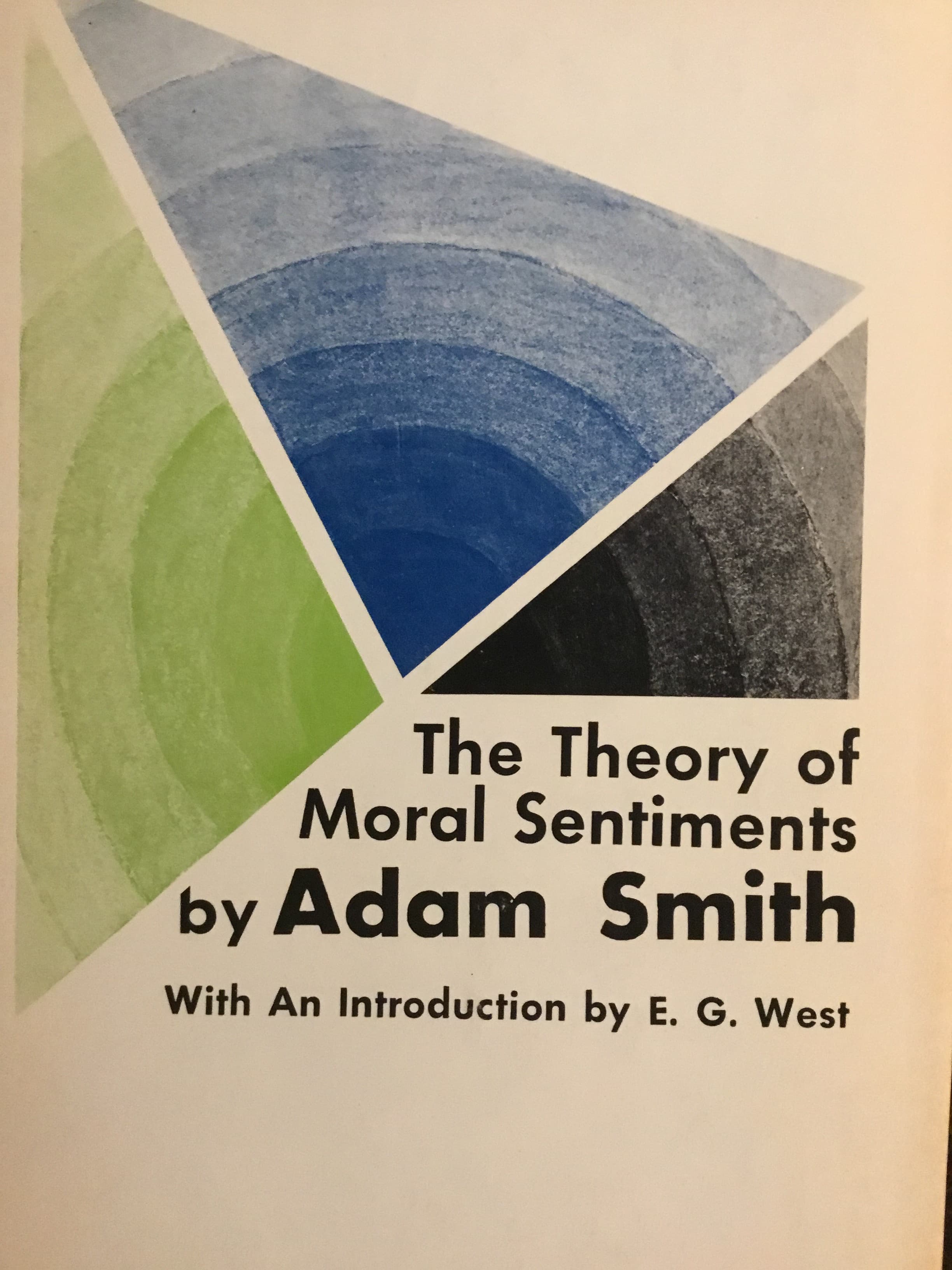
Teoria uczuć moralnych
Adam Smith